All Roads Lead to BPO
Written by Rob Carlo Elle • Board by Kim Pimentel | 5 October 26
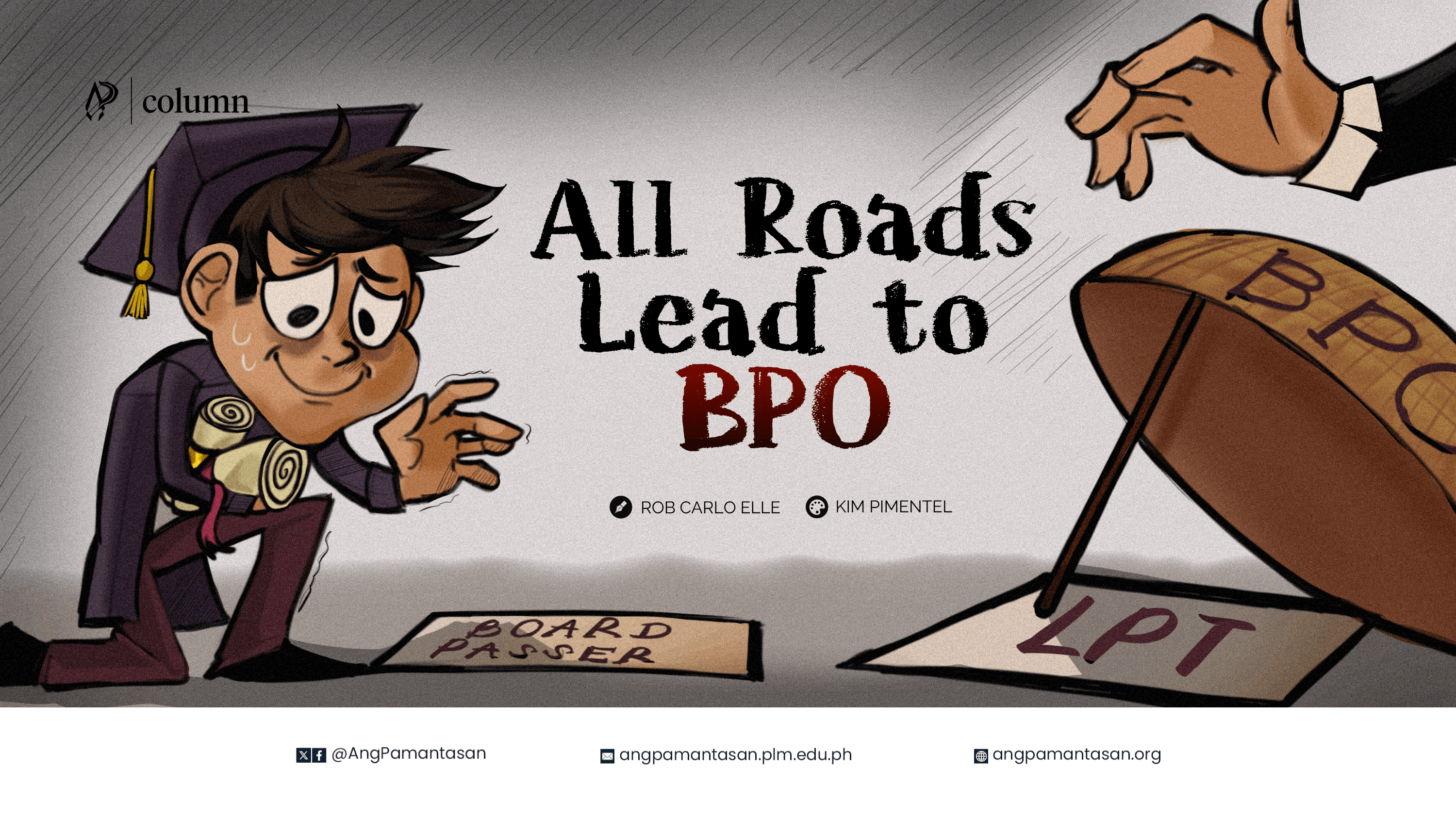
It may be just another customer-service call to you. But behind that audio call may be someone who chose sustainability over passion. A college graduate, a Latin honoree, or even a board passer once trained to stand before a classroom. In the Philippines, despite years spent earning a degree and a license, many education graduates find that all roads still lead to the BPO industry. As schools face a shortage of practicing teachers, those meant to teach within classroom walls are instead answering calls from office cubicles.
It is disheartening that teachers are pushed into a type of work their vocation never called them to do. The country’s slow and limited path to a teaching job makes it unclear for them to build an adequate life of their choosing.
The BPO industry has become a compelling alternative for Filipino graduates because it offers what many entry-level jobs struggle to provide right away. Faster hiring, competitive pay, allowances, benefits, and a structured workplace to develop skills. With millions of jobs supporting a multibillion-dollar industry, BPO companies present a practical path to financial stability.
This choice becomes clearer when entering the teaching profession is far from immediate. For aspiring public-school teachers, securing a position can mean months of processing requirements, locality and placement concerns, limited teaching items, and a waiting period that may stretch beyond six months or even a year. Private schools may offer a quicker entry, but often at salaries too low to match the demands and dignity of a teacher’s work.
My brother did exactly everything the system asked of him. He graduated magna cum laude, passed the licensure examination with a plausible rating, and ranked second in the division where he applied. For three years, he taught at a private school in our hometown for less than the minimum wage, enduring the sacrifice in hopes of earning a strong recommendation from the Schools Division Office.
Yet six months have passed without a call from the Department of Education (DepEd). Questions over what went wrong lingered, but my brother could not afford to wait indefinitely. In an economy like ours, standing still is a privilege only a few can afford. He needed to earn and move forward—even if it meant setting aside the profession he worked so hard to enter. The passion that once led him to the classroom now sits behind a headset in a BPO company. He did not fail the system—the system failed him.
Although my brother’s situation is not an isolated case, I cannot fault the growing number of education graduates and non-practicing LPTs who turn to the BPO industry. How can we question them for choosing the work that meets their needs, when the field they trained to serve continues to narrow its doors?
These very same doors, however, remain trapped in the government’s budget deliberations. Amid earlier reports of cuts to DepEd’s proposed budget, the House of Representatives recently approved its ₱975.96-billion allocation for 2027, while teacher recruitment remained among the department’s funding allotment. Yet, according to lawmakers, over the past years, more than 20,000 teaching positions have accumulated as vacant—making the crisis even harder to excuse.
The country is not short of qualified teachers; it is the government that fails to bring them into the classrooms that need them the most. A budget approval itself is not a solution if teaching posts remain empty, and education graduates await a long-delayed call in a society where uncertainty is unaffordable.
I cannot help but wonder what remains for those who still aspire to mold the minds of this country. I think of my brother, my batchmates—and more personally, myself. After the degree, the practice teaching, the licensure exam, and the promise we made to pledge, will our dreams be reduced to choosing whichever job can keep us afloat? Must Filipino teachers first abandon the classroom simply to afford the life that teaching was supposed to prepare them for?
We deserve better. This is not to diminish the BPO industry which produces dignified work and a lifeline for many Filipino families. But it should never become the country’s default answer to a profession it has allowed to become unsustainable. As the administration approves funding to upskill BPO workers, it speaks volume about how it sees Filipinos as workers whose efficiency can be sharpened and whose labor can be turned into long-term profit. It is disappointing that this appears to be its priority, while the development of Filipino children is given less urgency.
The administration must prioritize funding permanent teaching posts, make hiring faster and transparent, and offer pay and benefits that reflect the weight of a teacher’s responsibility. It must finally recognize teachers as the people on whom every Filipino student’s future stands. After all, a country cannot demand better learners while continually giving its best teachers stacks of reasons to leave.
It is not because they lack passion. I do not blame any education graduate or LPT who chooses to work in a call center. Bills cannot wait for teaching slots, and passion cannot feed a family on its own. There is dignity in answering calls, just as there is dignity in teaching. But I hope that someday, teachers like my brother will no longer have to choose between the two.
I hope they find their way back to the classrooms they once dreamed of entering—not only to teach lessons, but to raise students who know how to speak up and challenge a system that leaves people behind. Our calling should not end because the government failed to make room for us. Our calling shall continue to eradicate the system that presses us down.