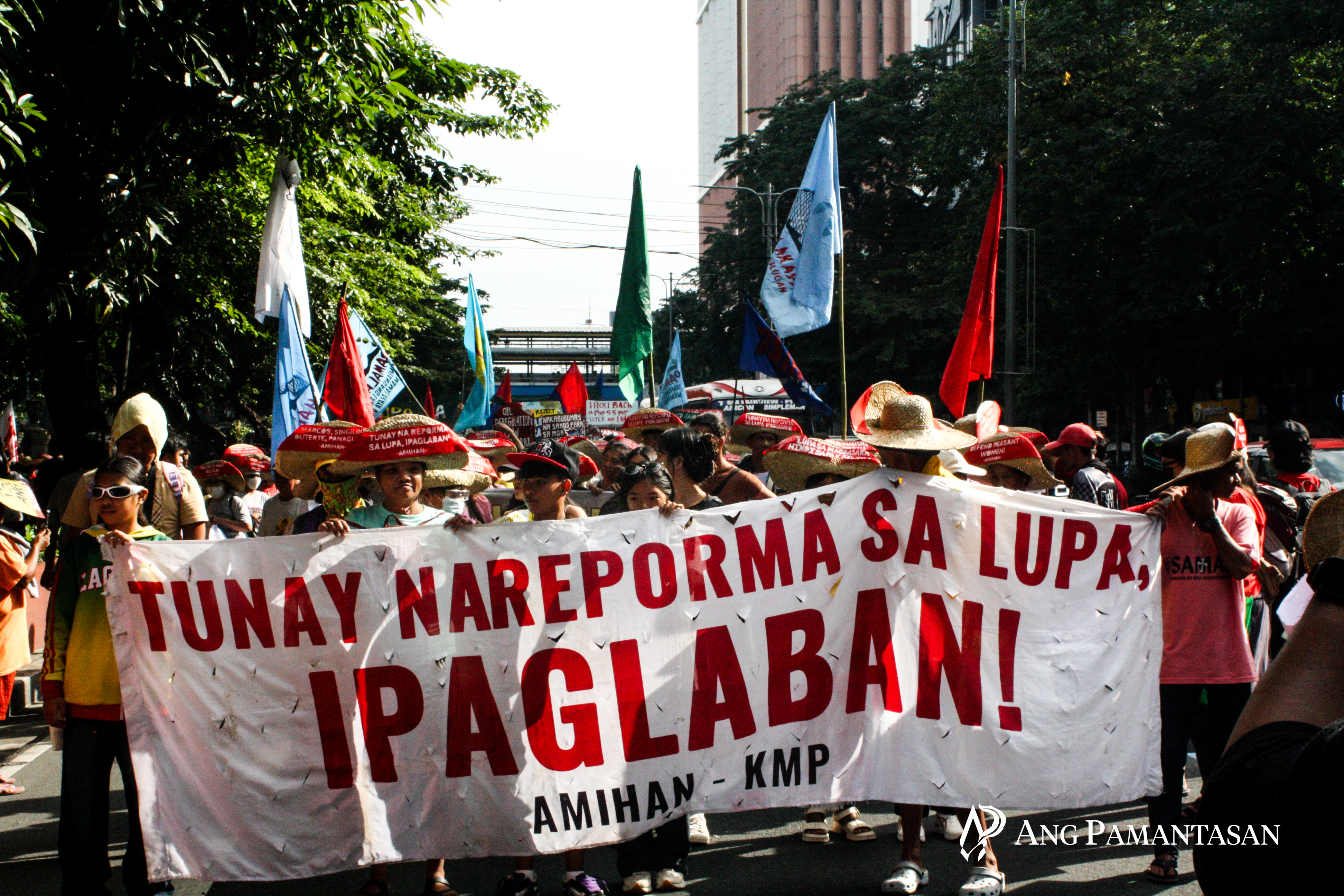
Farmers stage final Peasant Month mobilization, renew calls for genuine agrarian reform
Written by Aubrey Summer Nieva • Photos by Ella Mae De Asis | 22 October 26
Farmers from various regions across the Philippines gathered at the Mendiola Peace Arch on Wednesday, Oct. 21, for the last stage of the National Peasant Mobilization demanding genuine agrarian reform and expressing opposition to the exploitation of the country’s land and natural resources by foreign corporations.
The mobilization capped the Oct. 15–21 Kampuhang Magbubukid 2026, with more than a thousand attendees, organized by peasant groups, including the Kilusang Magbubukid ng Pilipinas (KMP), SAKA, and Rural Women Advocates (RUWA). The week-long campaign included protests, dialogues, and regional camp-outs at the Department of Environment and Natural Resources (DENR) and the Department of Agrarian Reform (DAR).
Coinciding with National Peasant Day, the demonstration renewed calls to resolve long-standing land disputes, halt the conversion of farmlands for commercial and industrial use, and prevent the displacement of farming communities. Protesters also pressed for land ownership, adequate irrigation, affordable agricultural supplies, fair rice grain prices, and compensation for crop losses amid risks associated with El Niño.
KMP chairperson Danilo “Ka Daning” Ramos criticized the Marcos Jr. administration for allegedly favoring corporate investments over rural communities. He cited mining operations and renewable energy developments led by AboitizPower, Vena Energy, and ACEN. He claims that these investments pose a threat to agricultural lands, ancestral lands, and fishing grounds.
The organization emphasized that its opposition was not directed at renewable energy itself but at projects that compromise communities’ access to land and livelihoods. It maintained that energy development should support national industrialization and address the needs of Filipinos.
Beyond land disputes, protesters also condemned the Philippines’ involvement in Pax Silica, a US-led initiative concerning critical minerals, semiconductor production, artificial intelligence infrastructure, and supply chains.
With United States of America (USA) President Donald Trump expected to visit the Philippines in November for the upcoming Association of Southeast Asian Nations (ASEAN) Summit, peasant-led groups warned that closer economic ties with the USA could further expose the country’s resources to foreign corporate interests.
Protesters also criticized Presidential Decree No. 27, in 1972 under the Marcos Sr. administration, which they claimed to “not truly serve” the interests of tenant farmers, and that the decree fell short of delivering the land ownership and security sought by farmers.
Accordingly, the Comprehensive Agrarian Reform Program (CARP), established in 1988 to redistribute agricultural land to qualified farmers and farmworkers, has yet to put an end to disputes over land access and ownership, according to the groups.
Peasant groups also denounced the reported harassment and criminalization of farmers, including Lucia Capaducio, who has faced accusations linked to her advocacy for farmers’ rights, as well as Indigenous peoples opposing land acquisition and resource extraction.
The mobilization highlighted the continuing calls of peasant groups and other sectors for agrarian reform, protection of rural livelihoods, and national sovereignty.
As the program concluded around noon, protesters sang “Bayan, Bayan, Bayan Ko” before dispersing peacefully.
Similar peasant-led mobilizations were also held in Isabela, Cebu, Negros, Panay, and Davao as part of the nationwide observance of Peasant Month.