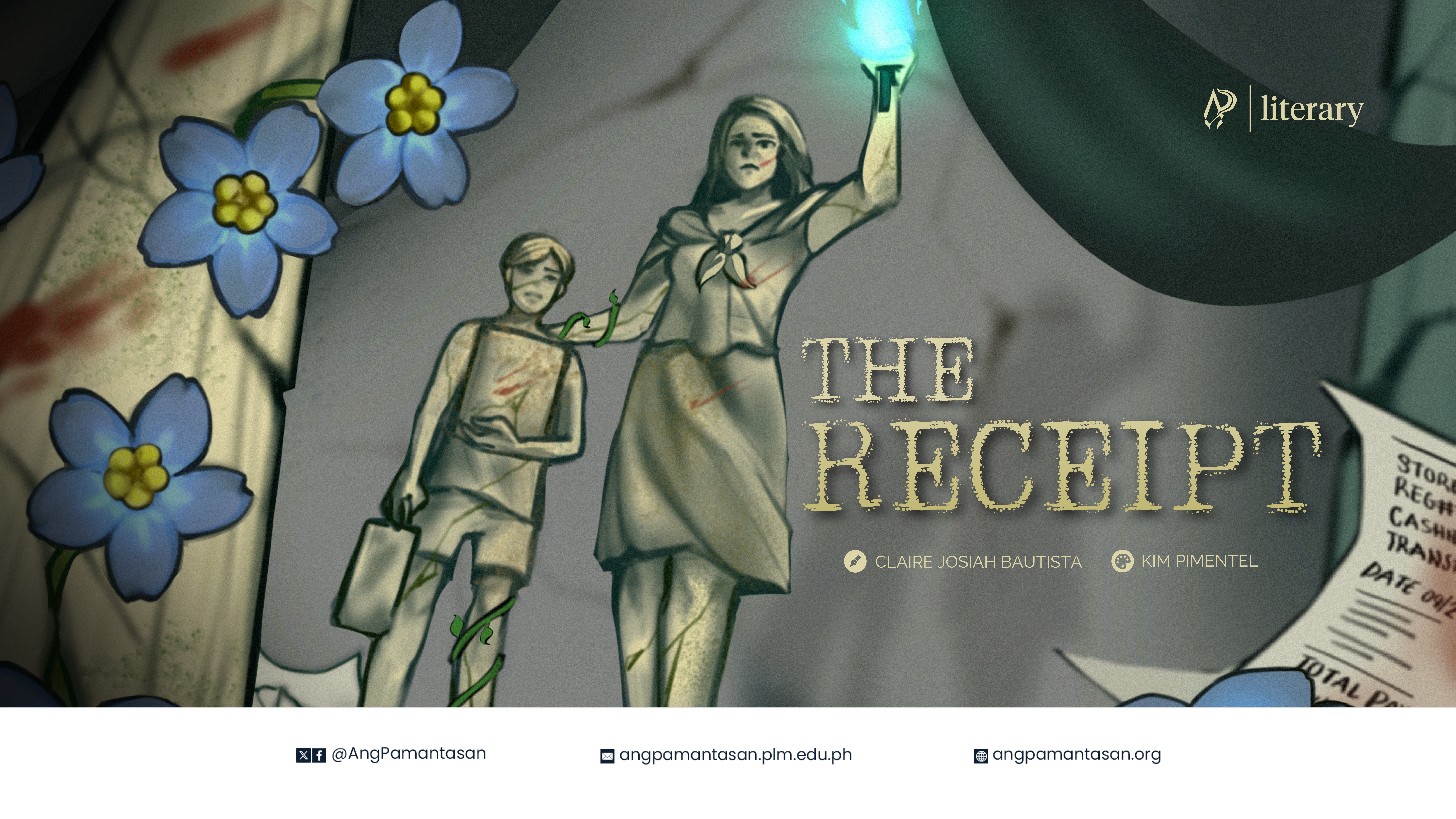
The Receipt
Written by Claire Josiah Bautista • Board by Kim Pimentel | 2 October 26
There is something almost unsettling about a receipt. It is such a small thing, easily folded into a pocket, forgotten beneath a pile of papers, left to yellow between the pages of a book. Yet for all its fragility, it remembers with a precision that people rarely possess. It keeps the date. It keeps the price. Most importantly, it keeps the transaction.
But the end of the day, it is only a piece of paper. And perhaps that is what makes it so easy to overlook. Nobody keeps the receipt for the sake of keeping it. We keep the goods instead—the food we ate, the clothes we wore, the things we brought home. Once the transaction is over, the paper becomes almost meaningless.
A country can survive the same way. It can build roads without asking what was spent to lay them, inherit houses without wondering whose hands once held the keys, and repeat stories without examining who was conveniently left out of them. The things received remain visible; the cost of receiving them does not.
So the country learned to remember what it had, rather than what it took to have it.
What it received was called a gift. What had been taken was described as an exchange. What was endured became the unfortunate cost of progress, and what was endured became the unfortunate cost of progress, and what could not be justified was eventually folded into the vague language of sacrifice. The words changed often enough that, in time, even their original meaning began to disappear.
Gratitude proved useful in this way.
It asks very little of the one who receives it. There is no need to know where the gift came from, what it replaced, or what was surrendered in return. One only has to say thank you.
And so the country became fluent in it.
Thank you for the road.
Thank you for the house.
Thank you for the peace.
Thank you for what we inherited.
The more often the words were spoken, the less necessary it seemed to ask what exactly they were thanking anyone for.
This is how debt can become an inheritance.
Not because the debt disappears, but because the story surrounding it does. A thing taken can be presented as something given. An obligation can be dressed in the language of generosity.
The strange part is that the receipt remains.
It survives in archives and photographs, in testimonies that refuse to become quiet, in names that continue appearing where they were once erased. Sometimes it is nothing more than a figure written in an old ledger. Sometimes it is a date someone insists on remembering. And sometimes it is the uncomfortable absence of a person who should have been there.
None of these things are particularly loud. They do not need to be. A receipt does not have to raise its voice to prove that something was purchased. It only has to remain.
And perhaps this is what makes the past so inconvenient. It does not always return as a grand revelation. More often, it appears in small discrepancies: a number that does not add up, a name missing from the photograph, a story whose polished surface begins to crack when someone asks a question it was never designed to answer.
Who paid? The question is simple enough. Its consequences are not.
Because once the price is remembered, the language of the gift becomes harder to maintain. Gratitude begins to look suspicious when it is demanded for something that was never freely given. Even inheritance becomes difficult to celebrate when what is inherited is not only land, wealth, names, and monuments, but also the silence surrounding how they were acquired.
Still, the receipt can be dismissed.
It is old.
It is incomplete.
The ink has faded.
There are always reasons not to read it too closely.
There will always be someone willing to say that the past is too distant to matter, that reopening it is unnecessary, that whatever happened has already been settled by time. As though time were a cashier. As though years alone could balance an account.
But history has never been particularly good at forgetting what people deliberately refuse to remember.
It waits. Beneath the official story, beneath the commemorations, beneath the portraits made respectable by distance, the old figures remain. The paper may deteriorate, the ink may blur, and the hands that once held the receipt may be gone. But still, somewhere, the transaction survives.
Perhaps that is the danger of teaching gratitude without teaching memory.
A generation may inherit the fruits of a past it never witnessed, but it can also inherit the silence that made those fruits possible. It may be taught to admire what was built without asking what was broken. It may learn to call a debt a blessing simply because that is the name it was given.
Eventually, the receipt becomes less a record of what was paid and more a reminder of what has been made difficult to remember.
And perhaps the most dangerous thing is not that the country lost the receipt. It is that it found it, read it, and still chose to call the transaction a gift.