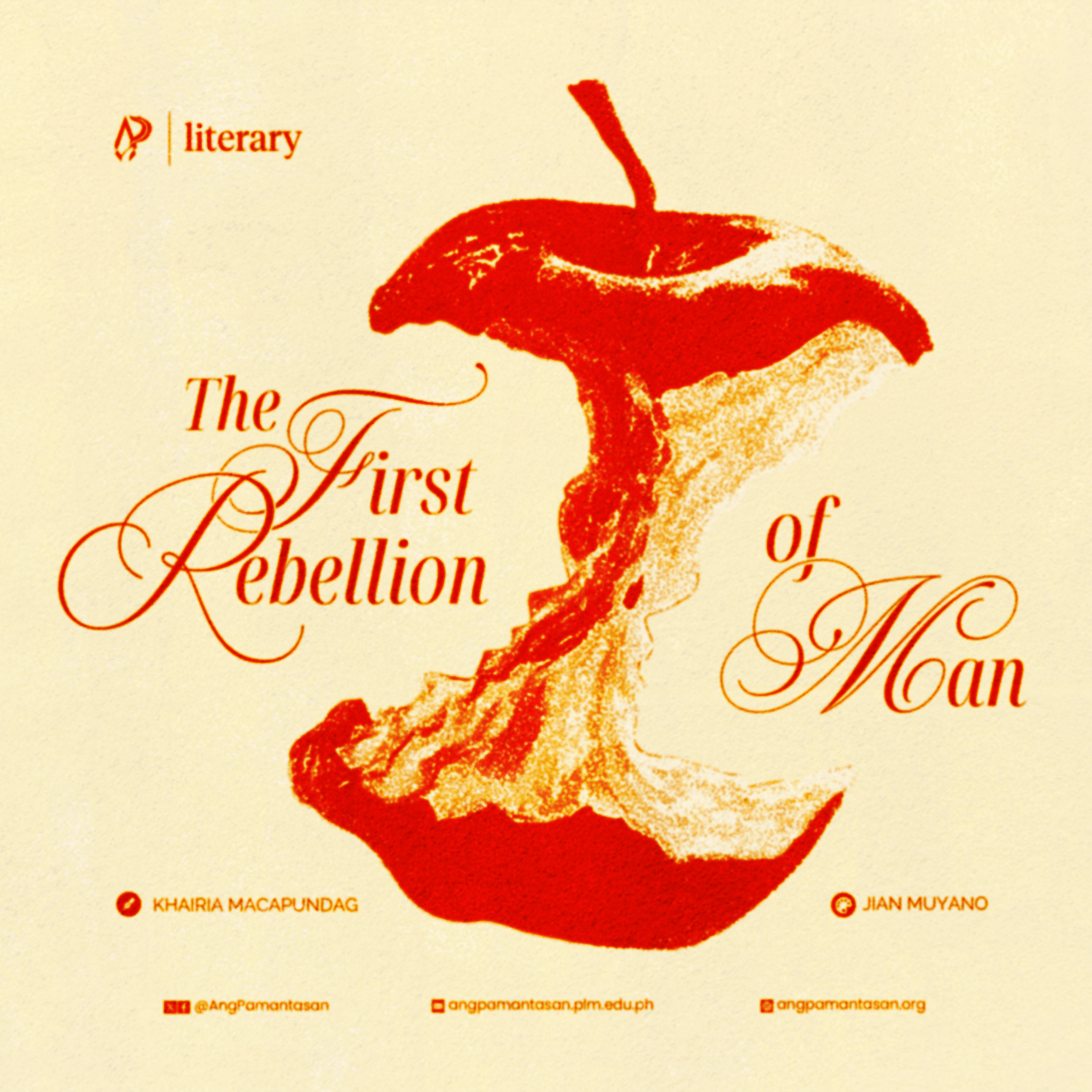
The First Rebellion of Man
Written by Khairia Gabrielle Macapundag • Board by Jian Muyano | 14 February 26
Who is to say that the beginning of mankind came from sin alone?
To say that we are predisposed to commit wrongdoing, to say that we are not capable of being inherently good? That our nature is one of corruption and disobedience?
As we are conceived and born, we are already assumed of transgression, children of wrath, brought forth in iniquity, with a propensity for violence. Is this the legacy of the first man? To inherit immorality, with a need for salvation that spans generations of humans?
Is it true that my conception, and that of those who came before me, was committed in sin? Have I been a sinner since I was born? When my first instinct was not to hurt, but to long for affection?
Even as I immerse myself in this ill-got world, it is this original sin that surrounds me. It is the foolishness bound up in the heart of children that grew, the intent of sin in a man’s heart, that walks upon the earth. It is what drives them to move, create, and amass into communities that build into societies and institutions. It is what created home and family, nurtured me into a being capable of compassion and trust.
It is through this that I wonder what the first man truly inflicted upon all of us, of sinners and saints.
Have I not sought the touch of my mother and the voice of my father the moment I arrived? Have I not looked for the laughter of my sister at my every jest, or the glint in my grandmother’s eyes at the melodies I sang for her? Have I not searched eyes for a woman whose hand I’d like to hold?
His image is what we embody, what was intended and shall prevail, but is overcome by resentment due to our vices and faults.
Yet what if the root of our failing is not mere rebellion but something closer to longing? Could it be that this ancestral failing is not one of temptation, but one of love? One that precedes rationality, divine grace, and moral fortitude? Is love not, and has always been, an act of radicalism? Is it not the fire that moves us, the pulse beneath my skin, the object that freed us?
The first man gives not merely sin, but the restless inheritance of love. It is dangerous, transformative, and world-making. Love is the most radical act— the first rebellion and the final redemption, the seed of every sin and the blossom of every grace. We are shaped in the image of love, driven by its very need, motivated by its presence. It has disordered and realigned us, burned this desire for genuineness and temptation.
It is love who freed us, and will continue to do so again.
To love in a world that rewards sin is to stand against tyranny, to forgive when it is known to bear no fruit. It is a blessing that we can love in contrast to the greed that tempts us to misplace it, to follow in the intention that was bestowed upon us. It is the true legacy, the strongest defiance, and the eternal gift.


