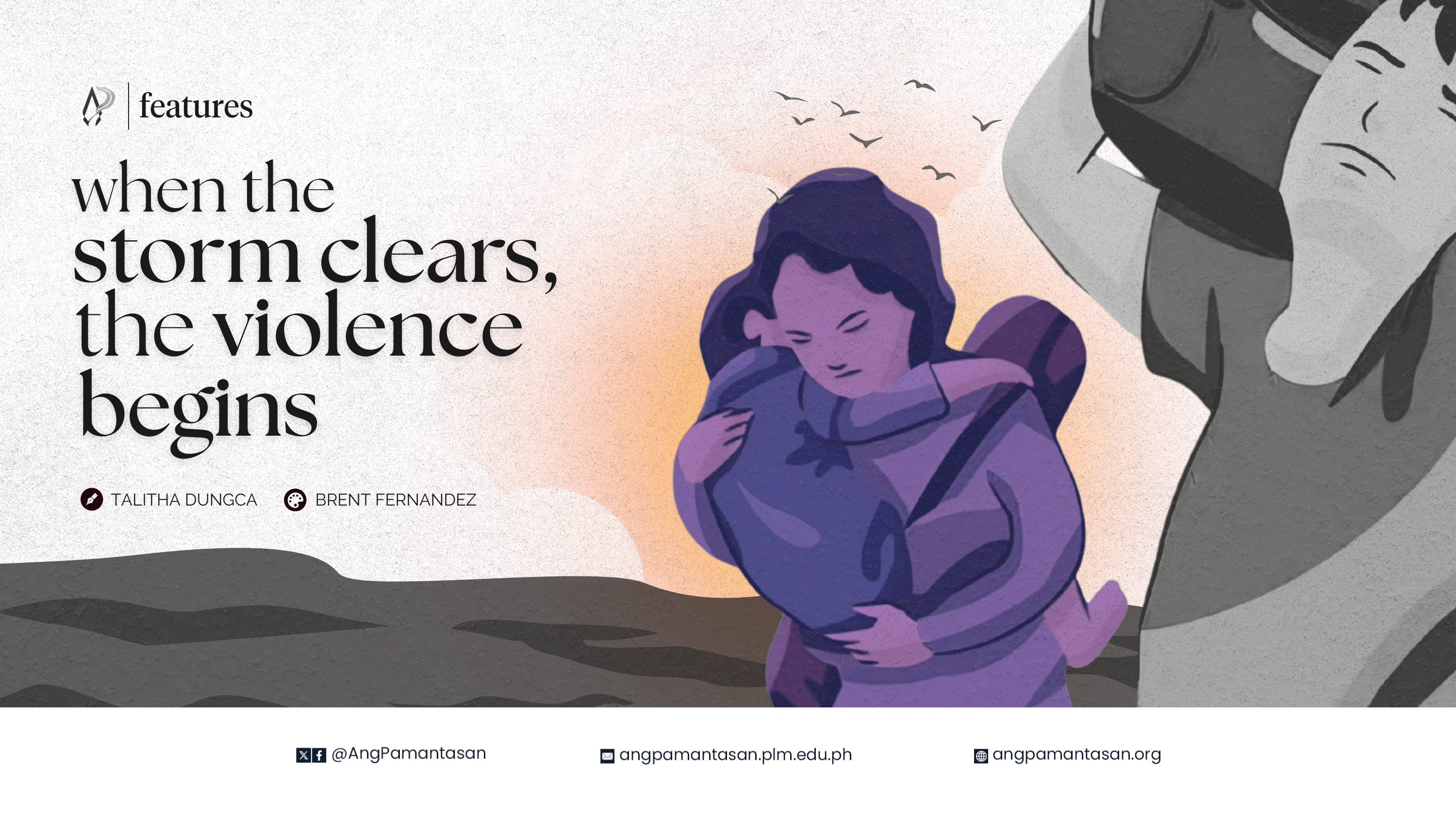
When the Storm Clears, the Violence Begins
Written by Talitha Dungca • Board by Brent Fernandez | 12 December 25
In the Philippines, every typhoon, flood, or earthquake leaves behind more than broken homes.
Women and children account for more than three-quarters of the displaced population in times of disasters, consistently among the most vulnerable, facing not only physical displacement but also abuse, neglect, and systematic exclusion. Yet the country’s disaster response continues to ignore their specific needs.
As the world marks the 16 Days of Activism against Gender-Based Violence, the need for real action has never been more urgent. Climate disasters heighten the threats faced by women and children.
And if every typhoon opens the door to another act of violence, then in a country struck by over 20 typhoons a year, we must ask: how much more can our people bear?
When the margin is at the limit
CEDAW defines women as a group experiencing gender based violence, classifying women as part of broader vulnerable groups like LGBTQIA+ individuals or children. Its guidelines allow for intersectional interpretations that can include transgender women and those facing multiple forms of discrimination.
Women and children are 14 times more likely to die in crises compared to men. As the climate becomes harsher, the violence they endure is often paired with even heavier economic burdens.
Privacy is scarce. Relief packs rarely include menstrual and feminine products. Toilets are shared and poorly lit. Pregnant women lose access to maternal care; girls are pulled out of school to help with caregiving and are forced into early labor as families struggle to survive. In the midst of these daily indignities, it is the women who are left to bleed continuously without the care they need.
When will women stop bleeding?
Menstruation is an experience met with emotions, confusion, fear and shame, followed by the increased risk of violence, which arise from inherent factors or inflicted through societal and perpetrator behaviors.
In 2024, around 50,000 women and girls worldwide were killed by their intimate partners or other family members. An average of 137 women and girls worldwide lost their lives every day at the hands of their partner or a close relative.
Women already bleed innately. But in times of floods and fractured ground, they are made to bleed even more, not by biology, but by violence.
In the same way, climate change affects women’s health in rarely discussed ways. UN Women calls climate change a “threat multiplier” because rising temperatures, food insecurity, and displacement intensify domestic violence and partner abuse—even a single degree of warming can raise the risk against them. Women farmers, though half of the global agricultural workforce, remain fragile in status and safety, owning only 13 percent of the land they cultivate.
In the Philippines, ranked as the fourth most climate-impacted globally, women and children face risks: super typhoons that devastate communities, droughts and heatwaves that threaten health and food supply, and destructive projects like mining and mega dams that erode biodiversity and livelihoods.
For instance, during typhoons, women often face physical violence from partners amid displacement, showing a 15-25% spike in gender-based violence post-disaster. If 10 women experienced abuse in a month, that rises to about 11–12 women after a typhoon.
According to WHO, heatwaves make women and girls have 1.5 times higher mortality rates than men due to their less access to water and shade. Children under five face 20-30% lower survival odds in drought-affected areas when gender-targeted aid such as undergarments for adolescent girls or feminine hygiene kits is absent. About six out of ten heatwave deaths are women and girls.
Just as menstruation reflects the silent endurance of women, climate injustice magnifies their vulnerability, exposing how a harsher planet multiplies violence and economic loss for women and children.
System change, not climate change
We need a systematic change, starting with political intervention that ensures the protection of women and children during disasters. Without systematic reforms, policies remain fragmented, and vulnerable populations continue to suffer disproportionately.
As we move towards the five year goal of cutting emissions by 2030 to prevent irreversible climate change, the Philippines commits to the UN Sustainable Development Goals, particularly SDG 5 (Gender Equality), SDG 11 (Sustainable Cities and Communities), and SDG 13 (Climate Action) knowing that gender-responsive approaches are essential for building resilient communities and protecting those most at risk from climate-related disasters.
With this urgency, Secretary Arsenio M. Balisacan pledged to realize the 2030 Agenda, warning that intensifying climate disasters threaten poverty reduction and development. The country has introduced the “Nationally Determined Contribution Gender Action Plan” (NDC GAP) 2024–2030, calling for gender-responsive climate laws and policies. The government has also publicly launched the NDC GAP to guide the integration of gender across climate sectors.
In the Philippines, SDG 5 is supported by the Magna Carta of Women (Republic Act 9710), which mandates gender-responsive disaster management and access to reproductive health. SDG 11 aligns with frameworks like the Philippine Disaster Risk Reduction and Management Act for sustainable urban planning, and SDG 13 is advanced through the NDC GAP for climate action pledges.
Yet execution remains weak: only 40% of local disaster plans incorporate gender-specific measures, per a 2022 UN Women assessment. Funding prioritizes infrastructure over gender-responsive interventions, leading to underfunded health and protection programs. Climate pledges under SDG 13 lack accountability, with inconsistent renewable transitions and "ghost projects" masking failures. These shortcomings amplify vulnerabilities for women and children during disasters.
Displacement from typhoons or floods leaves families without secure shelter, heightening exposure to violence. IFRC's 2021 report on "Gender-Based Violence in Disasters" shows GBV spikes by 20-30% in displacement camps, with inadequate protection leading to higher rape and harassment rates among women. Post-Haiyan surveys report women facing 25% more incidents due to unsecured sites.
Economic loss drives negative coping like transactional sex for income, bypassing health precautions WHO data links this to a 15-25% rise in HIV/STDs among displaced women, alongside increased unintended pregnancies and rape cases. Studies from climate-hit regions show women resorting to sex work, resulting in 20% higher STD prevalence.
Disasters worsen child trafficking, with families forcing early marriages or children being abducted for labor. UNICEF reports a 50% increase in trafficking cases in disaster zones, such as post-typhoon abductions for exploitation, perpetuating long-term harm and disrupting education.
Yet still, nothing happens.
When the system fails, climate justice isn't achieved, and almost automatically, humanitarian justice continues to be ignored.
Fight. Resist. Reclaim.
The 16 Days of Activism Against Gender-Based Violence remains a global movement rooted in grassroots resistance. It demands accountability, challenges power structures, and centers the voices of women and children.
Yet in recent years, official programs have shifted from calling it “activism” to “campaign,” a change many see as an effort to neutralize dissent, and this shift signals discomfort with radical change and a preference for controlled messaging.
But women and children do not need performance–-they need justice. They need actions that recognize their needs and protect their dignity. As the 16 days near its end, we must amplify their stories of struggle, resistance, and reclamation of rights, and disturb those who must be disturbed.
Women's and children's oppression must not be taken as a story only to be inspired by; rather, it must shape policy and public discourse.
Because in every storm, women and children always fight, resist, and reclaim; if only patriarchy were natural, it would not need violence to keep itself standing.