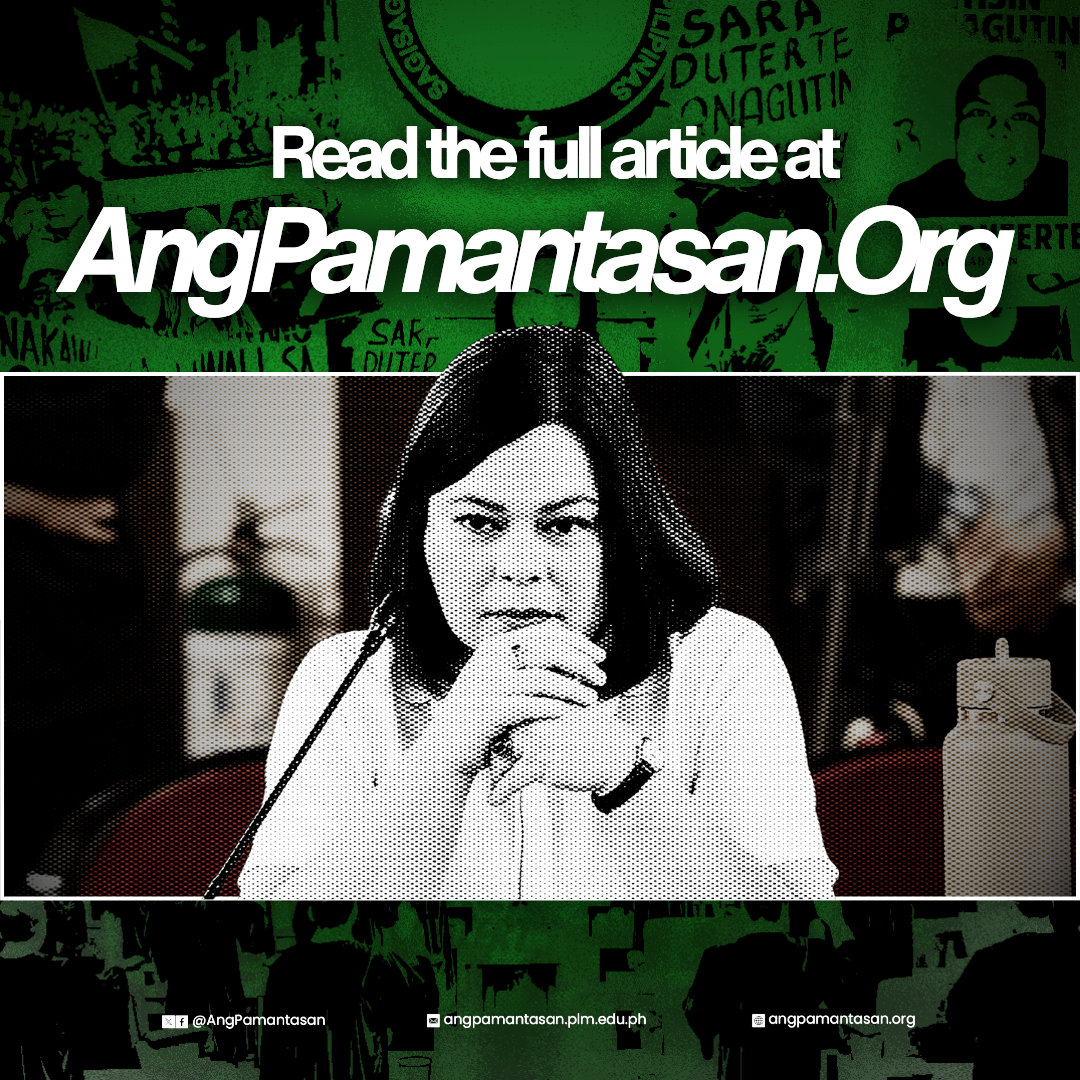
What Happens if Sara Loses Her Seat?
Written by Tali Dungca • Board by Jabiel Baliton | 11 November 26
For months, Sara Duterte’s impeachment has been more than a constitutional mandate. It reveals how political interests can become enmeshed in a country’s pursuit of accountability, making the process political even as it operates within constitutional rules. If convicted, Duterte would lose not only the Vice Presidency but also the authority, visibility, and institutional role that come with holding one of the country’s highest offices.
As her Senate impeachment trial continues, a conviction's consequences would reach far beyond the Senate walls—from Luzon to Mindanao, to the 2028 presidential race, and to how Filipinos understand power itself.
She loses the office
Impeachment is the constitutional process for determining whether a public official should be removed from office; conviction is what produces that consequence.
Under Article XI, Section 3(7) of the 1987 Constitution, an impeachment judgment also includes disqualification from holding any office under the Republic, meaning the Senate could potentially bar Duterte from holding public office in the future.
But that consequence has not happened yet. The impeachment proceedings have since taken a significant turn. On October 13, 2026, the Senate impeachment court accepted the House prosecution’s decision to withdraw three of the four Articles of Impeachment, leaving Article II on alleged unexplained wealth as the sole remaining charge. The allegation concerns Duterte’s financial disclosures, including discrepancies in her Statements of Assets, Liabilities and Net Worth (SALN), and her alleged failure to divest from prohibited business interests. The prosecution maintains that the financial evidence is sufficient to warrant her removal, while Duterte’s defense has yet to present its counter-evidence.
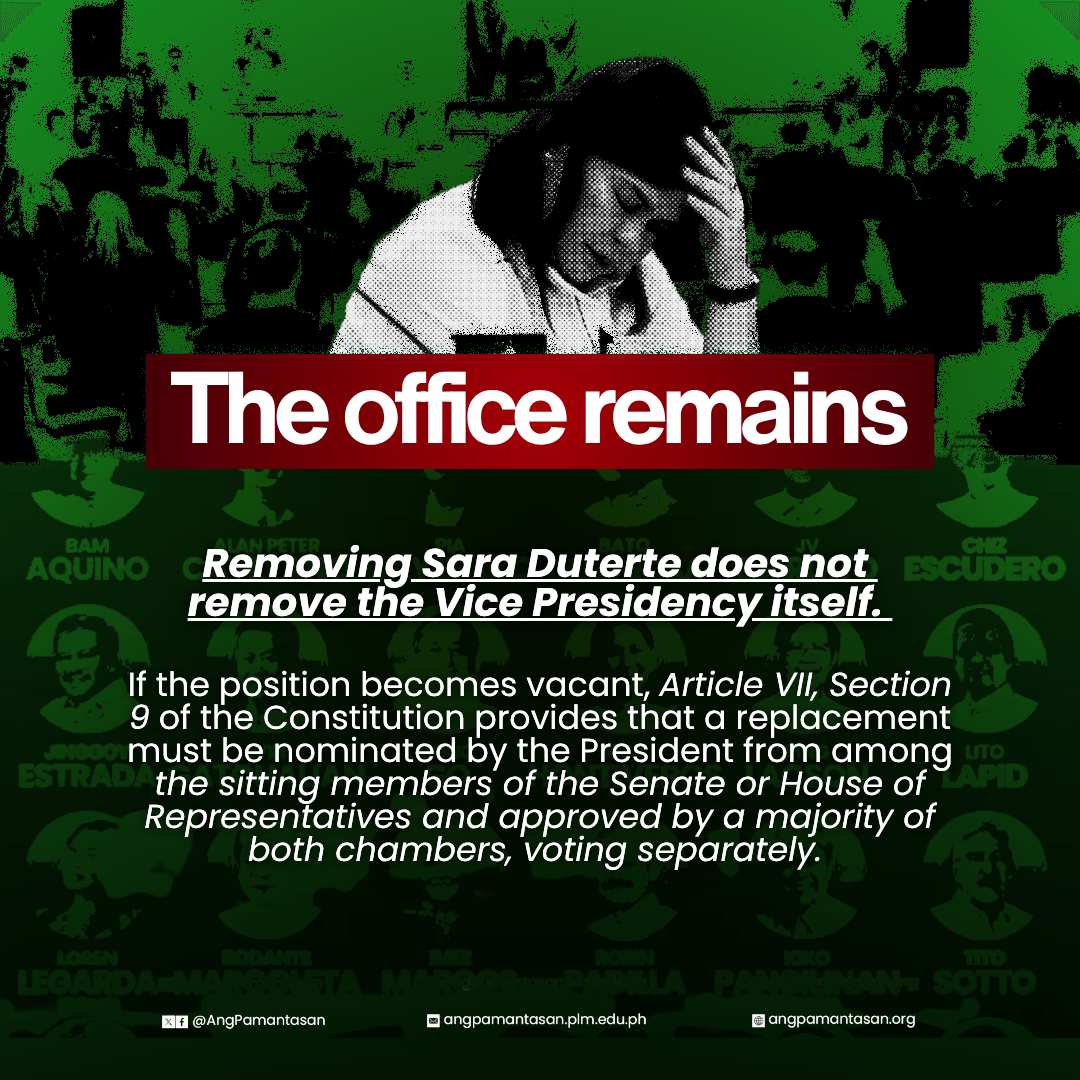
The office remains
Removing Sara Duterte does not remove the Vice Presidency itself. If the position becomes vacant, Article VII, Section 9 of the Constitution provides that a replacement must be nominated by the President from among the sitting members of the Senate or House of Representatives and approved by a majority of both chambers, voting separately. The office therefore continues even after its occupant is removed, with another politician potentially stepping into the role.
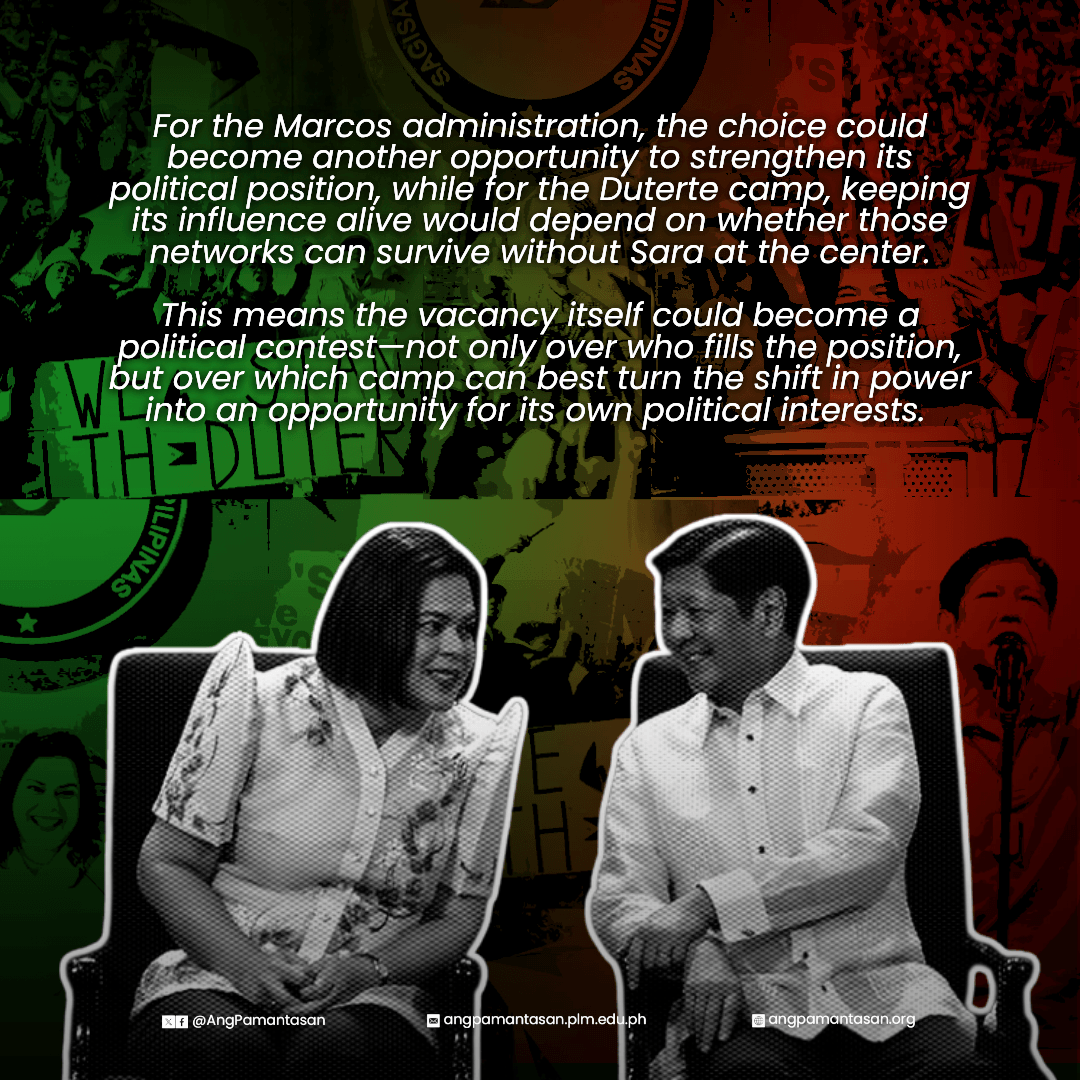
For the Marcos administration, the choice could become another opportunity to strengthen its political position, while for the Duterte camp, keeping its influence alive would depend on whether those networks can survive without Sara at the center. This means the vacancy itself could become a political contest—not only over who fills the position, but over which camp can best turn the shift in power into an opportunity for its own political interests.
A power shift
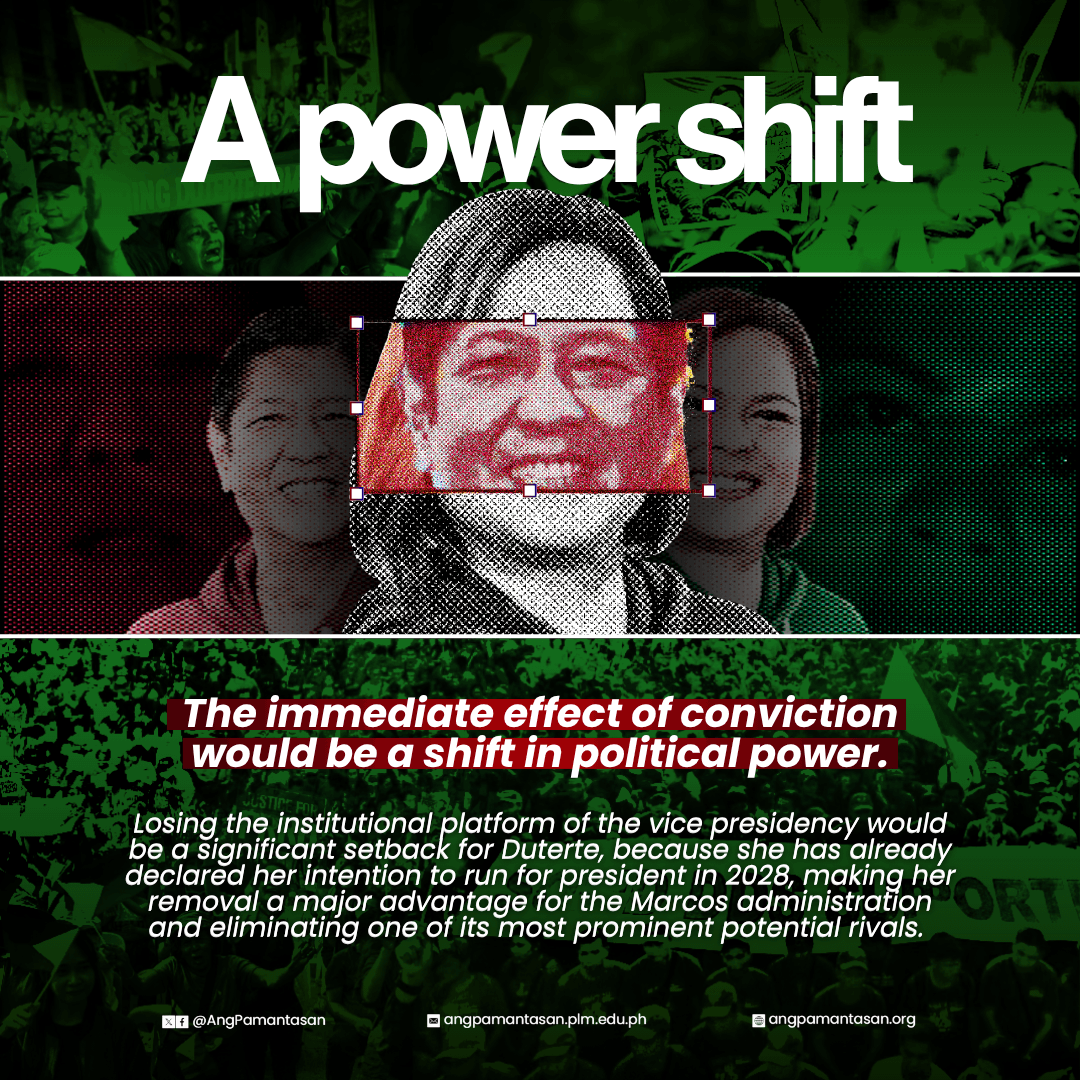
The immediate effect of conviction would be a shift in political power. Losing the institutional platform of the vice presidency would be a significant setback for Duterte, because she has already declared her intention to run for president in 2028, making her removal a major advantage for the Marcos administration and eliminating one of its most prominent potential rivals.
Yet this advantage could also come with costs, as Duterte supporters may view her conviction as an effort by the Marcos camp to weaken a powerful opponent, further deepening the divide between the two former allies whose “UniTeam” alliance helped secure victory in the 2022 elections.
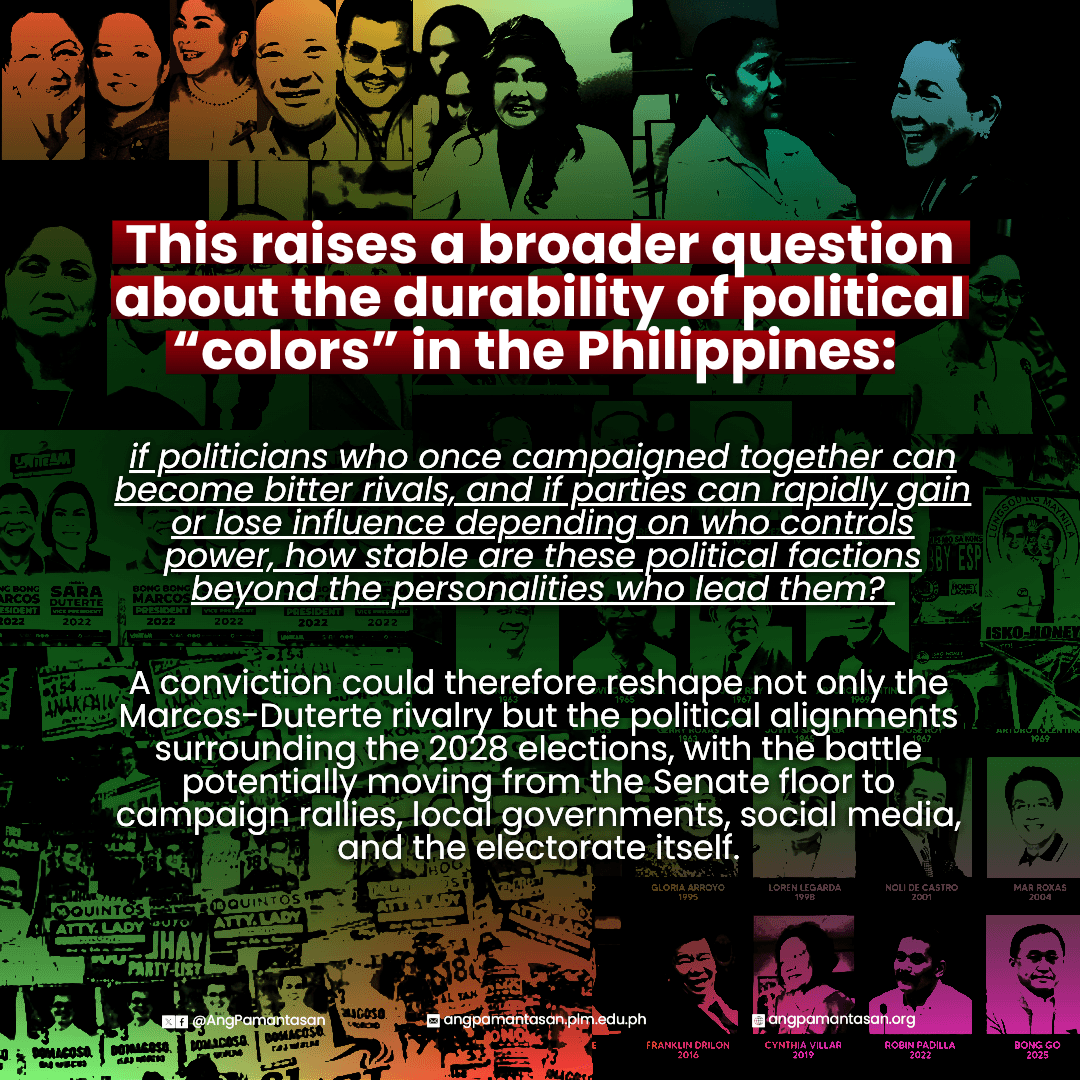
The collapse of the Duterte-aligned PDP, which went from more than 100 House members at its peak to fewer than five by 2025, also illustrates how quickly formal political alliances can change when power shifts. This raises a broader question about the durability of political “colors” in the Philippines: if politicians who once campaigned together can become bitter rivals, and if parties can rapidly gain or lose influence depending on who controls power, how stable are these political factions beyond the personalities who lead them?
A conviction could therefore reshape not only the Marcos-Duterte rivalry but the political alignments surrounding the 2028 elections, with the battle potentially moving from the Senate floor to campaign rallies, local governments, social media, and the electorate itself.
The Duterte Name
Whoever replaces Duterte would therefore inherit the vice presidency, but not automatically the Duterte name, regional following, or political network behind it.
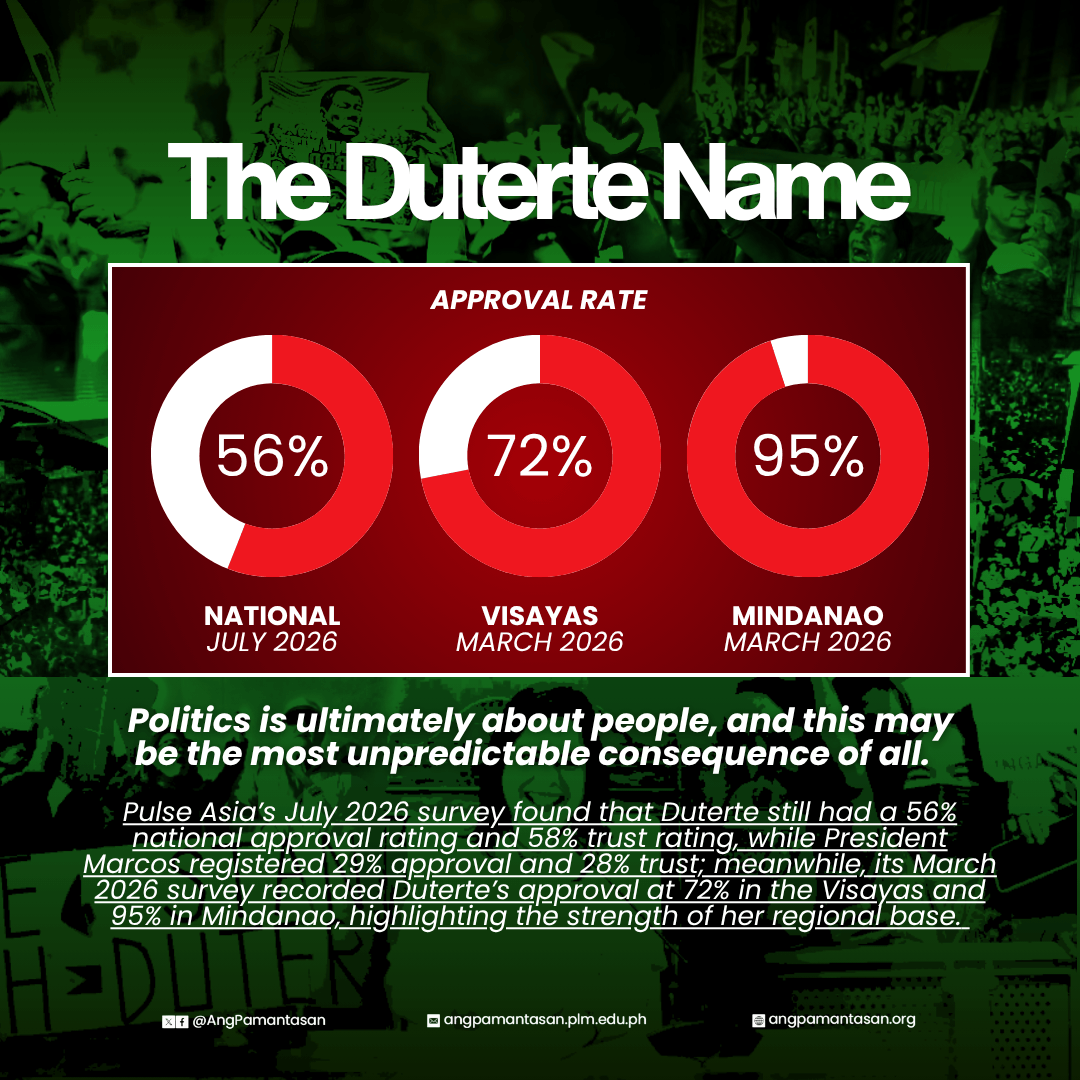
Politics is ultimately about people, and this may be the most unpredictable consequence of all. Removing a politician does not automatically remove the people who support her, and Duterte’s support has remained strong in certain regions in the country.
Pulse Asia’s July 2026 survey found that Duterte still had a 56% national approval rating and 58% trust rating, while President Marcos registered 29% approval and 28% trust; meanwhile, its March 2026 survey recorded Duterte’s approval at 72% in the Visayas and 95% in Mindanao, highlighting the strength of her regional base.
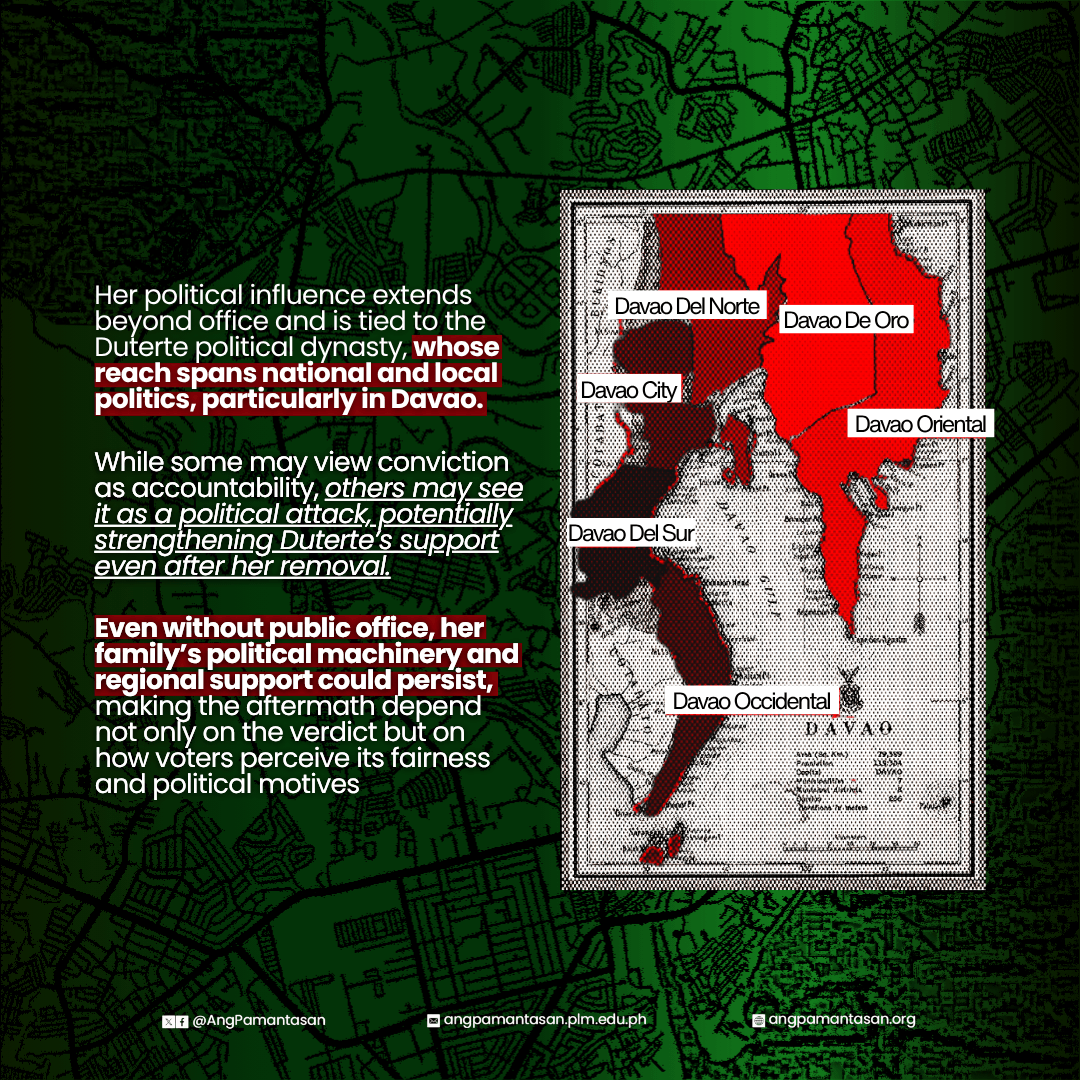
Her political influence extends beyond office and is tied to the Duterte political dynasty, whose reach spans national and local politics, particularly in Davao. While some may view conviction as accountability, others may see it as a political attack, potentially strengthening Duterte’s support even after her removal. Even without public office, her family’s political machinery and regional support could persist, making the aftermath depend not only on the verdict but on how voters perceive its fairness and political motives.
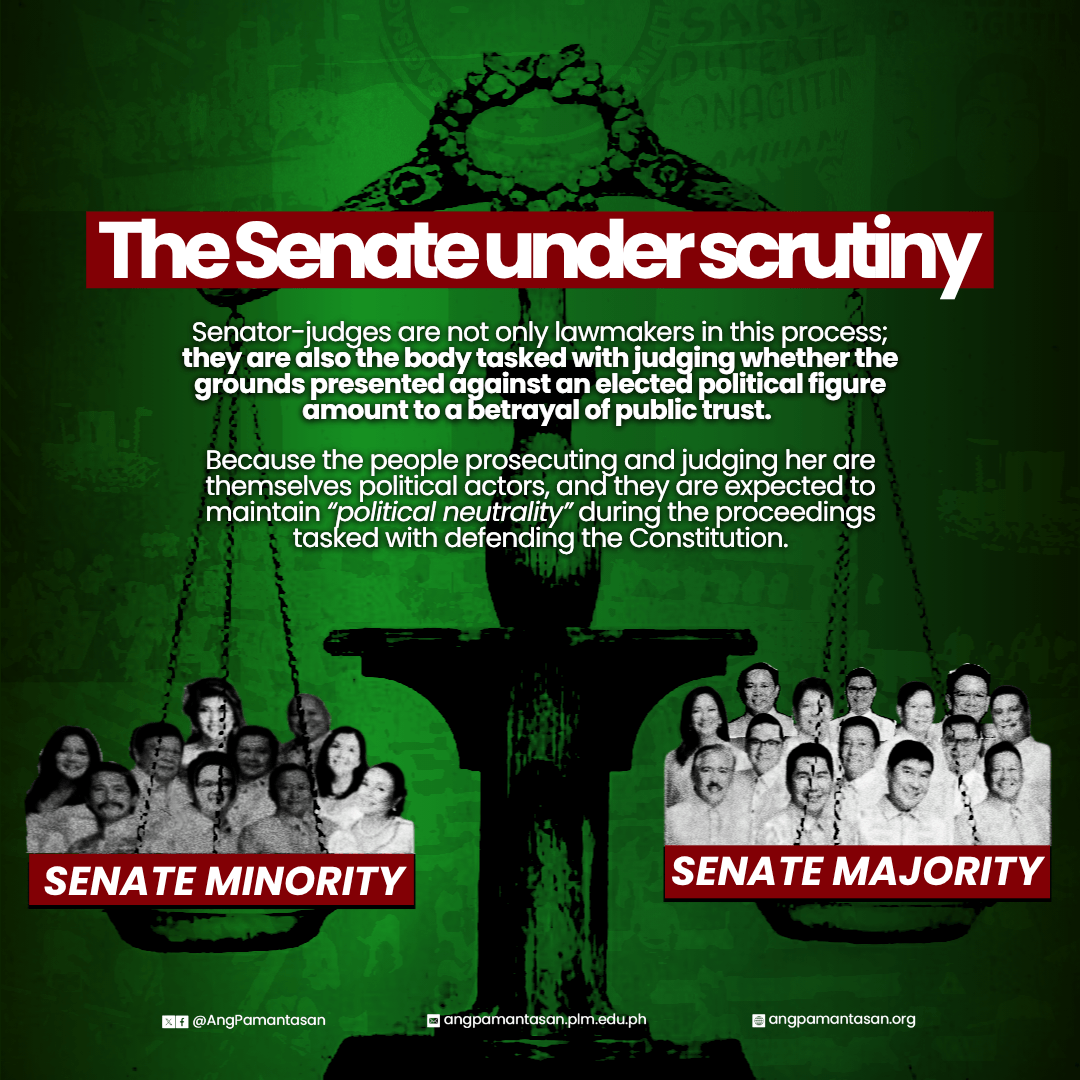
The Senate under scrutiny
Sara Duterte’s impeachment is political by nature, but that is precisely what makes the senator-judges’ role more consequential. Senator-judges are not only lawmakers in this process; they are also the body tasked with judging whether the grounds presented against an elected political figure amount to a betrayal of public trust. Because the people prosecuting and judging her are themselves political actors, and they are expected to maintain “political neutrality” during the proceedings tasked with defending the Constitution.
The trial therefore puts the Senate’s own legitimacy under scrutiny. Its decision could help define what the second chamber of legislation considers a “betrayal of public trust” and set a precedent for how accountability is applied to powerful officials. For Filipinos watching the proceedings, the question is not only whether Sara Duterte should remain in office, but whether the institution judging her can rise above the political interests surrounding the case.
In the end, the impeachment could become a test not just of Duterte’s accountability, but of how seriously the country’s political institutions take accountability itself.
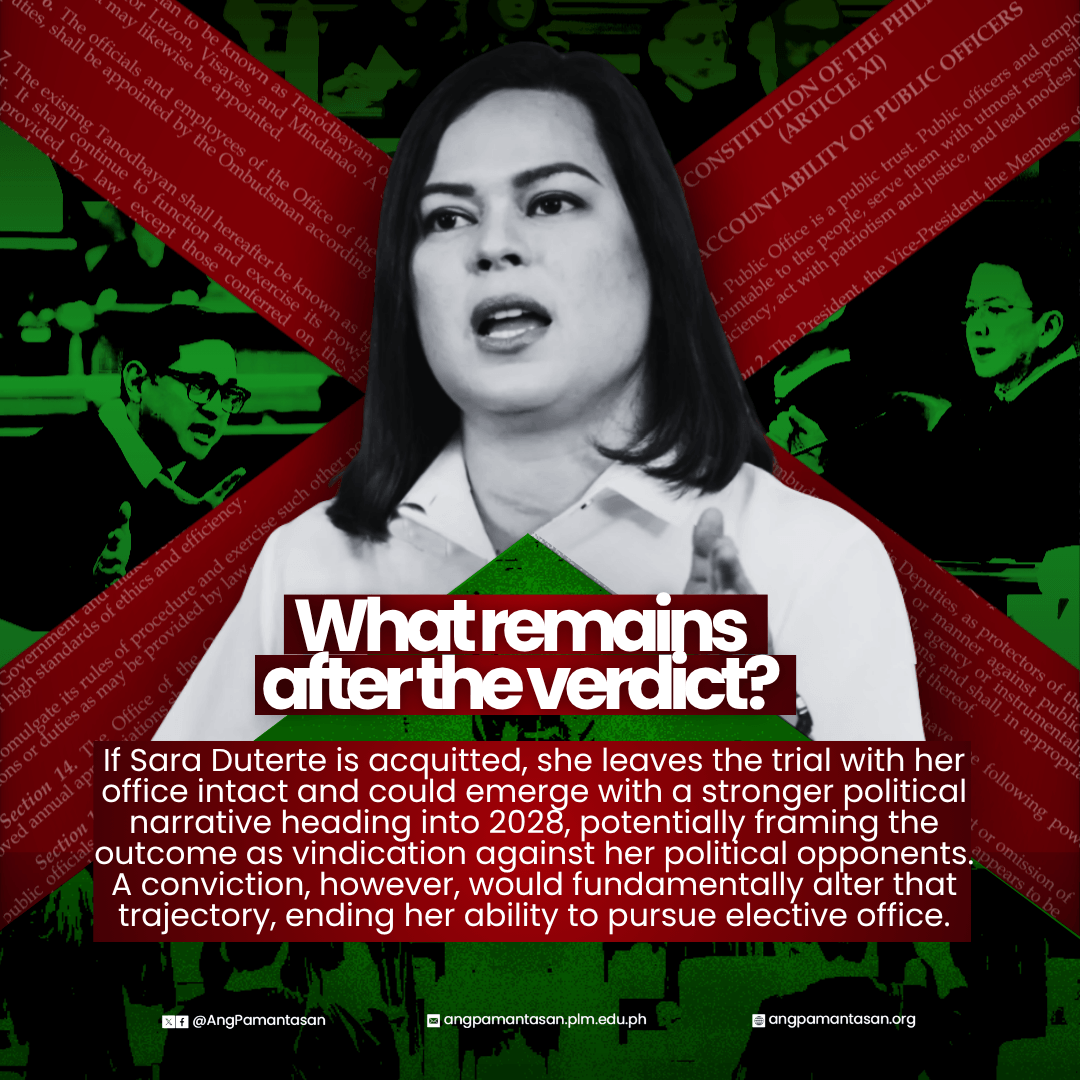
What remains after the verdict?
If Sara Duterte is acquitted, she leaves the trial with her office intact and could emerge with a stronger political narrative heading into 2028, potentially framing the outcome as vindication against her political opponents. A conviction, however, would fundamentally alter that trajectory, ending her ability to pursue elective office.
But beyond the political consequences, the impeachment could also serve as an eye-opener for ordinary Filipinos. As political camps compete for power, it raises a more fundamental question: who are those in public office ultimately serving—their political allies and ambitions, or the people who elected them? Political rivalries may shape elections and alliances, but they should not become the reason public office is exercised in the first place. At its core, government is meant to be about public service.
And this is where the consequences become most tangible. At the end of the day, whether Sara Duterte is convicted or acquitted, most Filipinos will still wake up to the same prices, same crisis, and the everyday concerns they encountered while commuting, at school, and even at their job. The impeachment may reshape the country’s political landscape, but it does not automatically change the realities people face.
The real question is not just “What Happens if Sara Loses Her Seat?”
It is what the country chooses to learn from it. The proceedings could force Filipinos to look beyond political colors and personalities and ask whether those in power are actually serving the public—or simply competing to hold on to power.