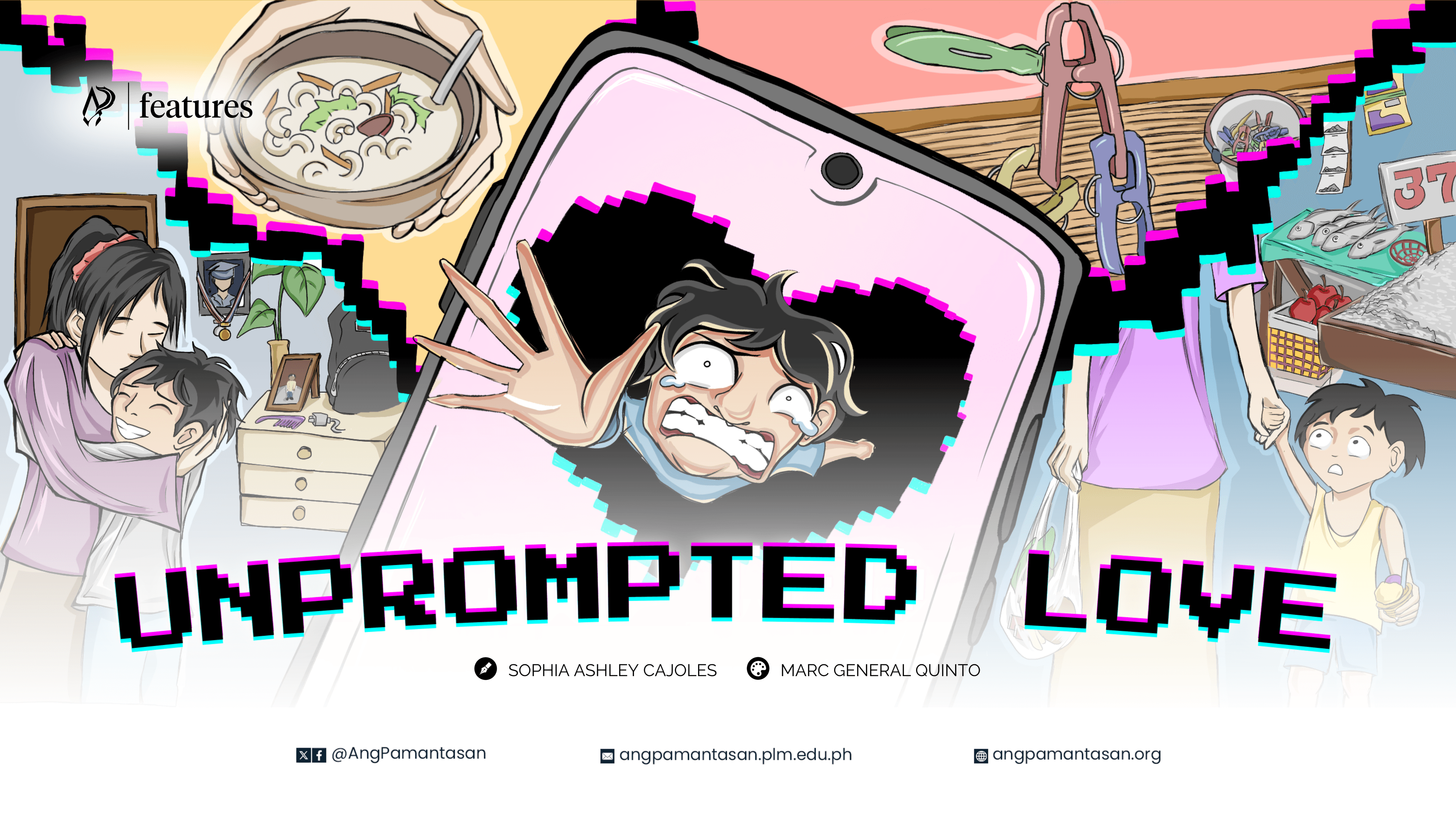
Unprompted Love
Written by Sophia Ashley Cajoles • Board by Marc General Quintos | 7 October 26
We now live in a world where children are seldom seen running in the streets or playing Chinese garter along eskinitas. Instead, many spend their days fettered to a glowing box of pixels, drawn into algorithms that seem to understand their interests better than the people around them.
Conversations that once unfolded face-to-face have been reduced to passing remarks of “Wait lang!” or “Just text me.”
As technology increasingly shapes the way children are today, the conversation extends beyond the screens and into the home. With technology finding its way into modern parenting, can there be a tutorial on unconditional love?
“No Results Found :(“
Parents and their children are more alike than either party would like to admit. Both are constantly adjusting to a world that never ceases changing, learning to navigate realities that did not exist decades ago. Yet, while children seem to adapt with ease, parents often find themselves struggling to keep pace.
For the younger generation, answers are often only a few taps away. From tutorials to explanations, information can just pop up on their screens for only a second. But for some parents, they do not enjoy the same accessibility. A search for "how do I talk to my child?" yields countless articles and videos, but no definitive guide exists for understanding another person, much less the child they are trying to raise.
As technology becomes increasingly woven into everyday life, many parents are left wondering where they fit into a world where information is readily accessible. In an age when children can learn almost anything online, the role of a parent extends far beyond providing answers—it lies in offering guidance through uncertainties that no search engine can solve.
A Connection Tethered to Love
Parental controls, passcodes, and content restrictions may shield children from certain dangers online, but they cannot protect them from everything that awaits beyond the screen. The digital world, much like the real one, is filled with unfamiliar paths, difficult choices, and challenges that no software can anticipate.
Technology can inform, entertain, and is a good avenue for connection, but it cannot replace the trust and guidance that parents provide. In a world increasingly shaped by algorithms, a parent’s presence remains one of the few constants in a child’s life. Who else would a child turn to at 9 pm for last-minute school supplies? Go above and beyond for school projects and costumes for events? A tutorial will only see you halfway, but when you gaze upon the crowd and see a smile on their face, a parent, undoubtedly, trumps a video.
The simple act of listening, showing up, and believing in one’s child carries a weight that no application or device can replicate. Long after passwords are forgotten and trends fade, the bond between parent and their child endures.
Though society continues down a digital path, parents remain essential in shaping how their children are brought up in this environment. As the saying goes, “A child’s first school is their home.” Whether celebrating victories or enduring failures, children often return to the comfort and reassurance that only a parent’s embrace can provide. No bright screen or empty words from a chatbot can replicate a parent’s love for their child.
Beyond the Screen
Technology has undoubtedly made almost everything easier. With a single search, people can learn a multitude of skills. Yet despite all its conveniences, technology cannot offer the warmth behind the words “I’m here for you,” nor can it replace the wisdom gained from lived experiences.
No video can fully teach patience, empathy, or unconditional love. These lessons are often learned not through screens, but through conversations, shared struggles, and the support of those who raise us.
As the world becomes increasingly digitized, perhaps the goal is not to compete with technology, but to recognize its limits. Devices may provide temporary comfort, but they cannot duplicate the human connection that defines parenthood.
A parent’s role extends far beyond that of a provider. It is a relationship built on trust, sacrifice, and unconditional, irrefutable love—a connection that no screen can replace nor an algorithm can imitate.