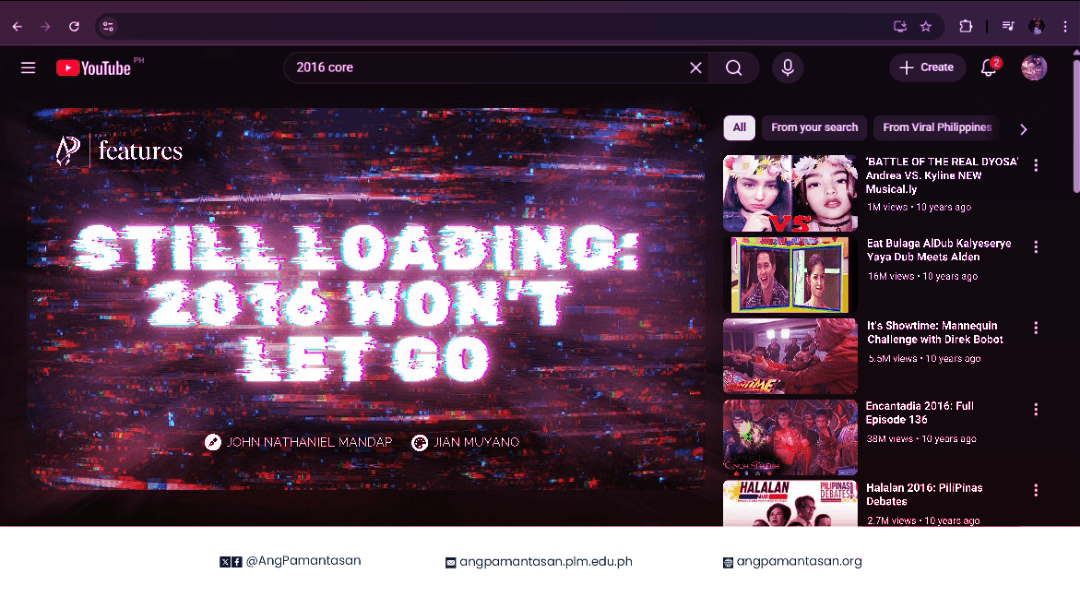
Still Loading: 2016 Won’t Let Go
Written by John Nathaniel Mandap • Board by Jian Muyano | 2 February 26
There is something about 2016 that refuses to stay in the past.
It does not announce itself. It simply appears—between posts, inside memories you thought you outgrew. A Vine was clipped and reposted on TikTok. A meme resurrected with a new caption. A song that plays for a few seconds, and suddenly you are thirteen again, commuting home on a jeepney, school ID still hanging from your neck, convinced that the world is still negotiable.
2016 returns not because we summon it, but because the internet remembers faster than we do.
The Year Everything Learned How to Go Viral
2016 felt loud, bright, and endlessly shareable. It was the internet before everyone fully learned how to monetize attention. Timelines felt less curated and more communal. Trends did not feel engineered; they happened.
This was the era of Vine humor that relied on timing, not outrage. Twitter (now X) was still a space for jokes typed during lectures, fleeting observations, and punchlines that did not aspire to permanence. Facebook timelines were flooded with personality quizzes, long captions that read like diary entries, and photo albums titled “random,” uploaded without much thought for cohesion or audience.
Locally, the internet felt closer to home. Noon-time conversations revolved around the latest Aldub episode, updates spreading faster than official announcements. Snapchat filters—flower crowns, dog ears, the unmistakable tongue flick—became staples of group chats and timelines. Classrooms briefly turned into sets for the Mannequin Challenge, hallways into attempts at Running Man. Everyone was online, but not yet exhausted by it.
Why We Keep Going Back
Lately, the internet has been asking us to look back.
A simple prompt: “POV: it’s you, ten years ago” has been enough to trigger a flood. Instagram stories comparing faces, captions joking about fashion choices and hairstyles best left undocumented. These posts appear harmless, even playful. But beneath them is a quieter longing, not just for how we looked, but for how life felt.
Music anchored memory, like the faint overflow of a classmate’s earphones drifting across the classroom, pulling you in just as the song begins: “Hey, I was doing just fine before I met you.”
From that single intro, you could tumble instantly into a classroom buzzing with whispered jokes and the scrape of chairs, a late-afternoon jeepney ride where the world blurred past the windows, a night under the covers with the glow of your phone painting your ceiling while pretending to sleep. Playlists back then weren’t meant to be curated—they were tiny time machines, jars of feeling you bottled up, shaking lightly whenever the track hit just right, spilling fragments of who you were and who you were becoming.
Culturally, it felt collective. Pokémon Go sent people outdoors—campuses, parks, street corners—turning strangers into temporary teammates chasing something virtual yet oddly communal.
We revisit 2016 because it was before the weight settled in. Before the pandemic reshaped time. Before adulthood became unavoidable. Before public life demanded constant positioning.
Back then, the future still felt abstract. Consequences felt distant. Time felt generous.
It is easier to scroll backwards than forward.
Why Nostalgia Persists
Nostalgia works because it edits.
It trims the awkward parts and amplifies the warmth. It remembers the laughter but dulls the anxiety. What remains is a highlight reel we can repost whenever the present feels too heavy.
For many, 2016 symbolizes youth without consequence. A time when opinions felt optional, when silence did not feel complicit, when joy did not require justification.
To repost these memories is to say: I was happy once. I was lighter once. I did not know everything yet. And in an era defined by fatigue and fracture, that admission feels comforting.
The Year We Prefer Not to Repost
But 2016 was not only memes and music.
It was also the year of the National election when the country first took a glance at how quickly virality could be weaponized. Troll farms professionalized disinformation, packaging fear and resentment in the language of relatability. Violence was reframed as discipline, killings recast as justice, and extrajudicial deaths—overwhelmingly borne by the poor—were normalized as collateral for order.
This was not a side effect of the year. It was part of its architecture.
Yet this version of 2016 rarely trends. It does not resurface as easily. Nostalgia renders it inconvenient, easier to scroll past than confront.
Commemoration Without Amnesia
So the question is not whether we should remember 2016. The question is how.
That year revealed the Filipino instinct to make the ordinary—extraordinary. Classrooms and hallways became stages for quick Mannequin Challenges, impromptu dance-offs, or lip-sync battles, captured on shaky iPhone 6s videos that zipped across Facebook groups. Afternoon jeepney rides turned into quick playlist sessions, friends humming along to Aldub’s latest serenade or swapping YouTube covers, earbuds tangled but laughter free.
Even the smallest spaces—milk tea chains, sari-sari stores, barangay streets—became laboratories for jokes, memes, and fleeting moments of connection. On Twitter and Facebook, Tagalog hashtags like #hugot and #relatable threaded communities together, turning playful sarcasm into tiny acts of shared storytelling.
It was a year that celebrated inventiveness not in galleries or stages, but in the everyday, the ways Filipinos found beauty, laughter, and connection in the spaces they already inhabited.
We can revisit the joy without romanticizing the harm. We can replay the songs, laugh at the old jokes, and still acknowledge that the same year deepened class divides and taught the nation how charm could mask control.
Every memory we repost carries context, whether we name it or not. Nostalgia often feels apolitical because it is quiet. But silence has always been one of the loudest positions.
Remembering is not the danger. Forgetting selectively is.
Now, a decade later in 2026, we’ve grown, shifts in algorithms and trends came and went, and we look back not only to reminisce but to learn. Because when nostalgia does all the editing, history returns not as warning, but as comfort—and that is often how it learns to repeat itself.