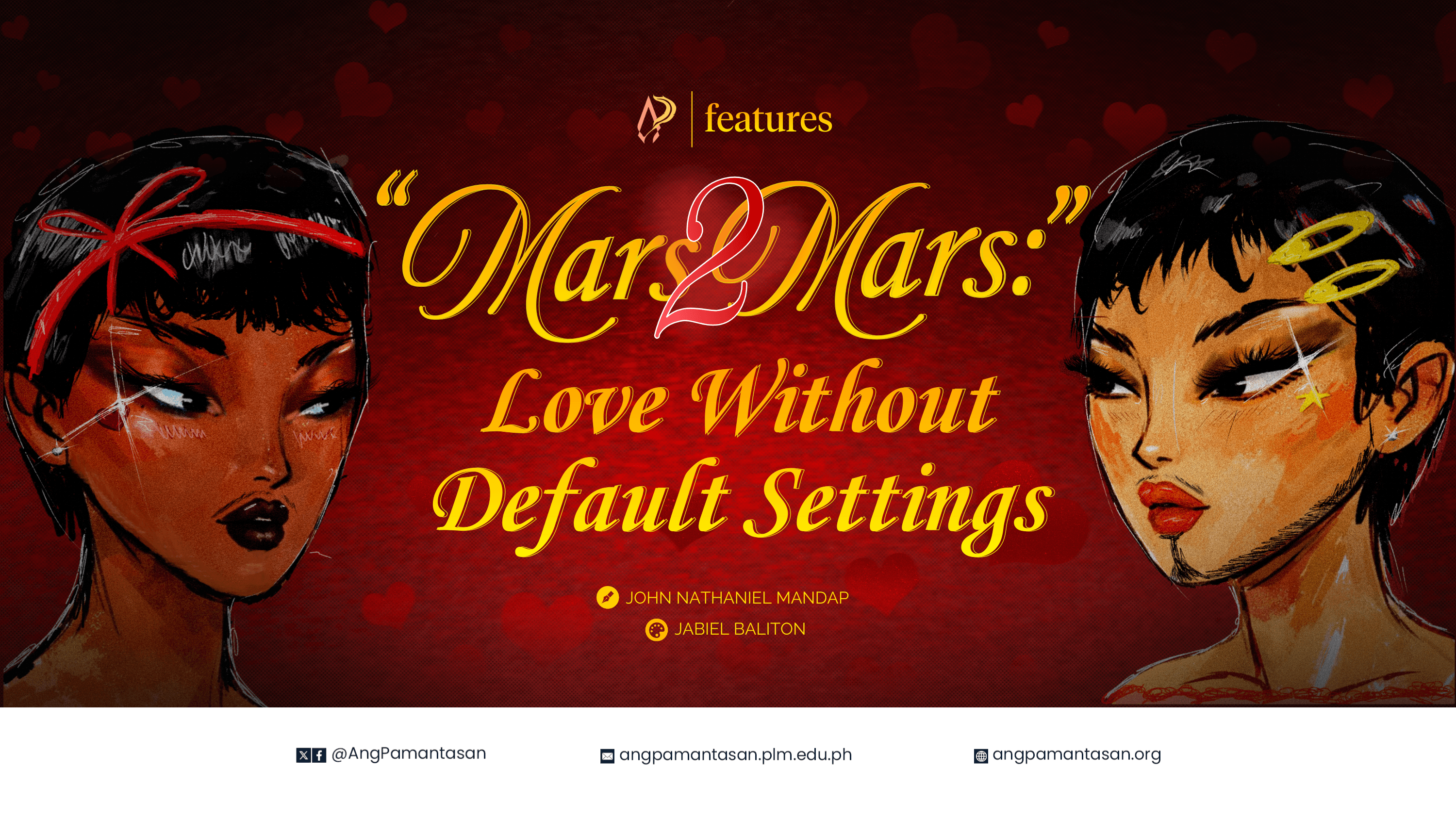
“Mars2Mars:” Love Without Default Settings
Written by John Nathaniel Mandap • Board by Jabiel Baliton | 22 February 26
For the longest time, love came with instructions.
Unwritten, but everywhere. Passed down through movies, sermons, sitcom punchlines, and childhood games where someone always had to play the bride, and someone always had to play the groom. Society did not just teach people who to love; it taught them what love should look like. Masculine meets feminine. Leader meets follower. Protector meets protected. The script was clear. The roles were assigned.
Then, as the pages turned, the script got rewritten.
Same-sex love fought its way into visibility, into law, into family group chats and Facebook timelines. Slowly, painfully, the idea of two men loving each other stopped being unthinkable and started becoming negotiable. Then tolerable. Then, at times, celebrated.
But somewhere along the way, a quieter rule stayed untouched: even in queer love, someone still was still expected to play the “man,” as if love could not exist without the question: “So… sino ang lalaki sa inyong dalawa?”
And now, that rule is starting to feel outdated.
Rules? What Rules?
Inside the LGBT community, masculinity and femininity never truly disappeared; they just changed wardrobes.
Masc4Masc profiles. Dating advice that quietly suggested “balance.” Jokes about who opens the jar, who pays the bill, and who walks closer to the street. Even in spaces built to escape heteronormativity, its shadows lingered in subtler ways. The expectation was rarely spoken aloud, but it hovered in preferences, conversations, and quiet discomfort.
The assumption felt familiar, and the relationship still needed to feel legible. Comfortable. Nakasanayan.
Love, after all, was easier to accept when it resembled something people already knew.
Feed Full of Feels
Then came the scroll.
TikTok confessionals. Comment sections turning into mini forums. Storytimes layered with humor and vulnerability. Suddenly, the algorithm began surfacing couples that did not follow the old balance at all—two effeminate men, two soft energies, two people refusing the idea that someone had to perform masculinity just to make love make sense.
“Mars-to-Mars” relationships began appearing everywhere at once, not just as satirical punchlines, but as everyday love stories.
And the reaction was immediate.
“Marehan?” “Lasunan?” “Parehong gelatin?”
Curiosity. Support. Confusion. Fascination. Hindi sanay.
Not rejection. Not hostility. Just unfamiliarity.
Which made the conversation more complicated and more honest. Because the discomfort was no longer coming only from the outside world. It was coming from within the spectrum itself.
Kilig, But Make it Soft
There are kinds of love that even people within the LGBT community are still learning to recognize.
Not because they are wrong. But because many people are still learning to look at love without borrowed lenses.
For decades, queer love had to prove its legitimacy by showing how similar it could be to heterosexual love—stable, balanced, respectable, familiar. It was a survival strategy, social negotiation, and emotional self-defense.
But survival scripts do not always age well.
Now, as more people grow comfortable living openly, the question shifts. It is no longer just ‘Can queer love exist?’ It becomes ‘Does queer love have to imitate straight love to be valid?’
And that question creates tension. If relationships stop following the old template, the template itself becomes unnecessary.
No Roles, Just Love
Valentine’s Day love’s a formula. Flowers. Chocolates. Candlelit dinners arranged in pairs that fit neatly into romantic expectations. It thrives on symmetry and familiarity.
But outside those tidy displays, love keeps expanding.
Some relationships do not need masculine energy to feel complete. Some couples do not feel the need to balance softness with hardness, femininity with masculinity, tradition with rebellion. Some love stories simply exist without assigning roles first.
And that is where the real shift happens.
Because when love stops asking who plays the man, the old measuring tools stop working. The categories blur. The scripts fall apart. The confinement to history becomes deschackled. The expectations lose their authority.
There are forms of love that even people within the LGBT community are still not used to seeing—not because they are wrong, but because love is still being viewed through a lens borrowed from a heteronormative world.
And that is where things become messy.
If the same old measurements still define what counts as love, then the purpose of being part of a spectrum begins to blur.
Maybe love is not breaking.
Maybe it is finally uninstalling the default settings.