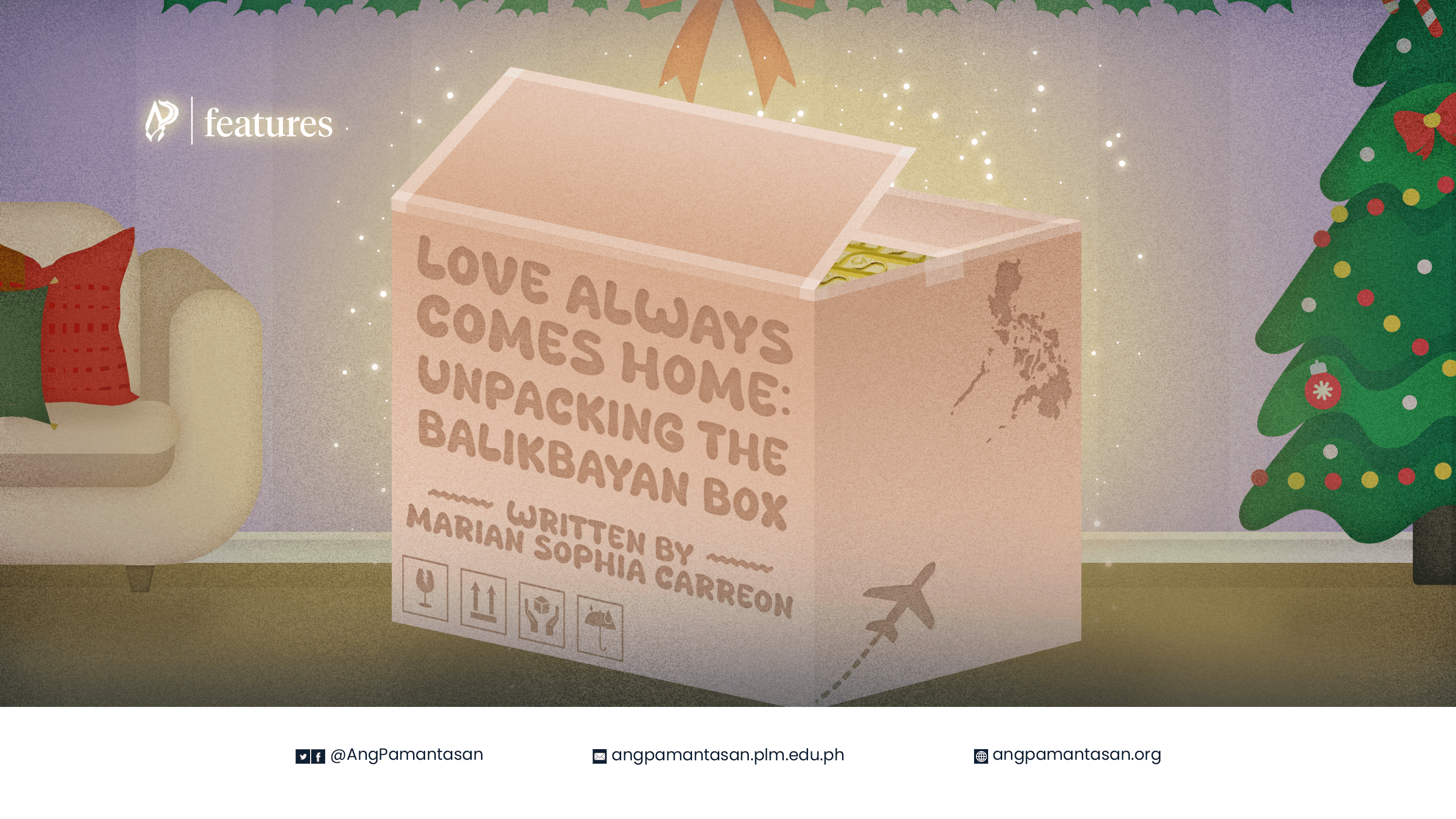
Love Always Comes Home: Unpacking the Balikbayan Box
Written by Marian Sophia Carreon • Board by Angelle Valbuena | 1 January 24
“Atin na kaya ‘yan?” Echoes of excitement fill the house as family members peer through windows to catch a glimpse of the LBC truck in the neighborhood. As if the long-awaited promise has taken form, Balikbayan boxes are delivered on doorsteps, believed to be carrying not only souvenirs from a foreign land but also the heartfelt sentiments of a family member working abroad. This long-standing tradition takes place in Christmas and for the much-eager Filipinos, gifts pour in as early as September.
Having begun in the 1980’s during the Marcos regime, the term, “balik-bayan,” is a combination of two words: balik meaning “return” and bayan meaning “place”- sometimes translated as “home.” It was coined to inspire nationalism and reinforce connection between families despite a distance spanning seas apart due to its tax-free incentives back then. Ranging from cans of Vienna sausage and Spam to Victoria Secret perfumes and branded clothing, a Balikbayan box contains desired products that are cheaper when bought in other countries or believed to have better quality than local ones.
And with how the number of OFWs have been fluctuating over the years, it seems plausible that more boxes are on the way. As per the 2022 survey of the Social Weather Stations, 1 out of 5 Filipinos aspire to live abroad while there are currently 1.96 million OFWs. It is not a stretch to say that foreign horizons have always been a great standard of success for Filipinos where a better life is promised– a product of colonialist ideals where Western commodities reign superior over local ones.
These adapted values of quality have shone a light upon American products as symbols of modernity and luxury in Philippine society, fueling the social prestige that can only be afforded by an OFW’s family. Being a prominent mark of diaspora, Balikbayan boxes bridge the emotional divide between Filipinos overseas and their loved ones back home while narrating a story of migration, hope, and resilience.
All for the Family
In the Filipino culture, no words can ever sufficiently describe the bond of a family as it is held in the highest regard, an absolute in the life of every Filipino. Family has always been the foremost priority, driving many to work abroad in hopes of affording life’s comfort and luxuries in a poverty-filled country. With Balikbayan boxes, OFWs send out a message that they are still with the family; however, along with that loving reminder, it is a box stamped with a strong message of sacrifice. Fueling the Filipinos’ theme of sacrificial love, Balikbayan boxes perpetuate a cycle of resilience for the OFW and utang na loob for the receiver, which is most often their children. Consequently, this debt of gratitude lingers among the children as they learn to pay it through questionless obedience and devotion for their family.
Sa susunod ay ako naman ang tutulong.
There has always been a social cost in exchange for this dream, and with the growing number of Filipino emigrants, this ideology is being passed down generations because we never learn or, better yet, have a choice to stay and find success in our own country. Working overseas was once seen as a means of escaping poverty, and now, poverty has become such a commodity that the path of becoming an OFW has turned into a custom, even expectation. Balikbayan boxes embody the social obligation existing between the OFW and receiver, ingraining a sense of duty and commitment out of this sacrifice. With this, the social cost extends towards a need for reciprocity, a constant yearning from both sides to receive any indication of “I remember you.”
A House is Different from a Home
Moving abroad was their golden ticket out of poverty and through it, Filipinos earn wages they could never have dreamt of in the Philippines. But despite this, OFWs suffer a spiritual and cultural dislocation in a country that is not their own. The glorified backdrop of an OFW would always have a shadow of sacrifice and homesickness, molded into regrets of what they have missed at home. Challenges of liminality arise where they are stuck between here and there, having to adjust to an entirely new place that some never do. Since no matter its issues, there is still no place like home.
Initially used to describe a Filipino returning home, what now remains is a special symbolic box that, in a way, serves as a proxy of a person that should have been there in the important season of Christmas. More than a love letter, it can also be a gift of guilt, meant to replace the presence of the OFW themself- an absence bubble-wrapped by precious luxuries and souvenirs to deem it unnoticeable.
The Balikbayan box is an iconic representation of the resilience and adaptability in the unwavering Filipino spirit upon the harsh landscape of diaspora. Rather than its contents, perhaps what matters most is the preparation and thoughtfulness weaved into the creation of the box. A cardboard box that was born out of a necessity to deliver items has become a tradition of sacrifice, togetherness, and family within the global community of Filipinos; all of which can ultimately be traced down to what stays through trials of time and distance– love.