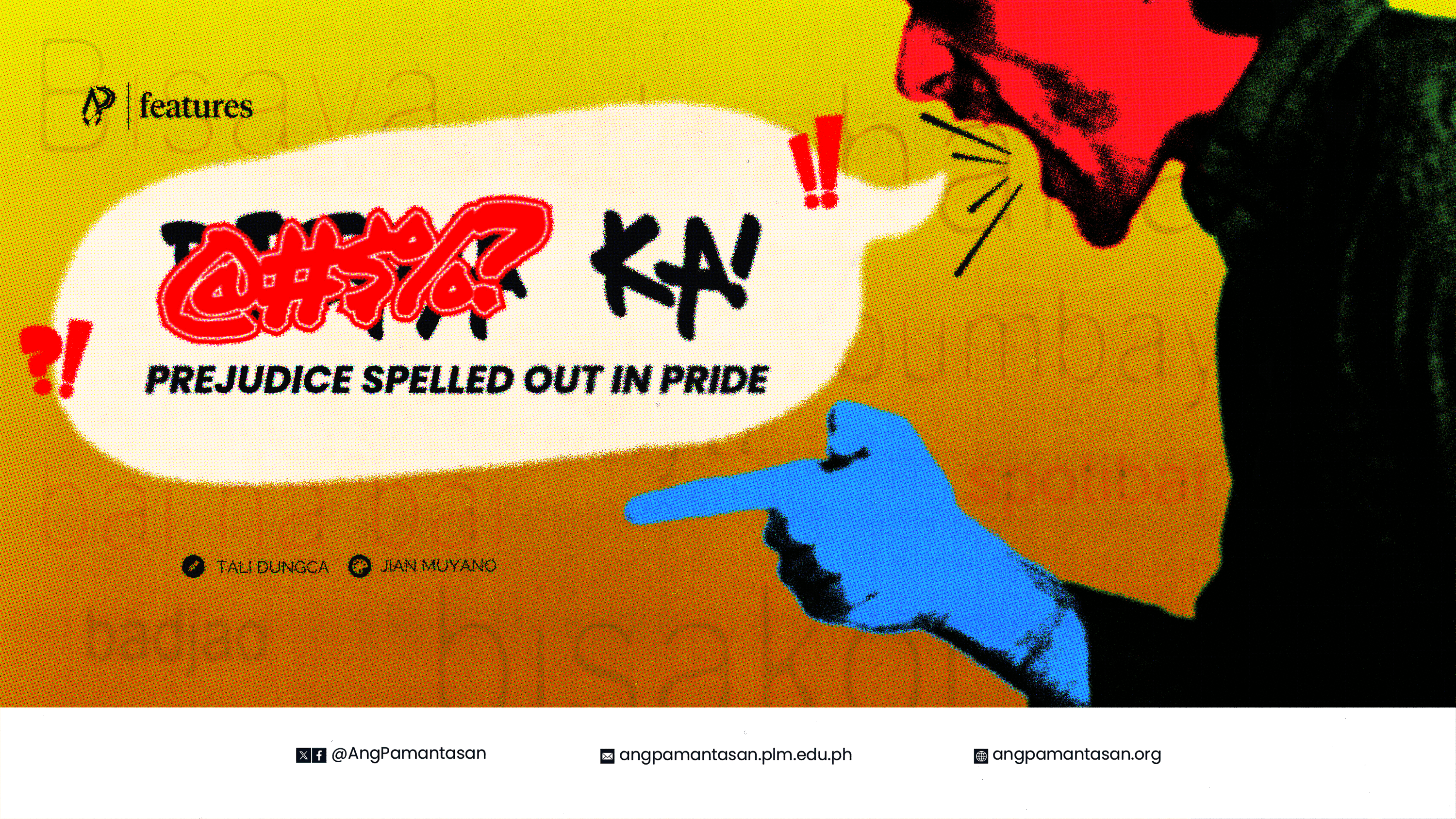
@#$%? ka!: Prejudice Spelled Out in Pride
Written by Talitha Dungca • Board by Jian Muyano | 16 September 26
For generations, Filipinos have proudly worn the label of being among the world's most hospitable people. We celebrate our warmth, kindness, and ability to welcome strangers with open arms.
The country is shaped by remarkable cultural diversity. We speak different languages, carry distinct traditions, and come from communities with their own histories. The government itself recognizes this plurality, through national cultural policies that respect the identities of different localities, regions, and ethnolinguistic communities.
We often celebrate this diversity as part of what makes us Filipino. Yet the same differences we proudly claim as part of our identity can also become the basis for our judgment. What begins as a stereotype can easily become prejudice—a preconceived notion that reduces people to where they come from, how they speak, or the communities they belong to.
These prejudices are not confined only into thoughts; they surface in everyday conversations, online humor, and the language we casually use with one another. In the Philippines,"Bisaya" becomes an insult instead of an identity. "Taga-Mindanao" becomes shorthand for being left behind. Accents are imitated for laughs, while indigenous communities are reduced to caricatures rather than being humanized.
Perhaps the harder question is: what happens when prejudice becomes so ordinary that we no longer recognize it?
Bias in disguise
Language often reveals prejudice long before people recognize it.
Among many Filipinos, "Bisaya" has become more than a regional identity. It has been transformed to mock someone's appearance or fashion preferences. Someone acting awkwardly is dismissed as "Bisaya." Even words like “bisakol” are weaponized to imply inferiority.
The same pattern appears elsewhere. Indian moneylenders become "bumbay" stereotypes in comedy. Chinese Filipinos are still asked whether they are "Filipino enough" or diminished to “intsik beho.” Mixed-race Filipinos often have their identity questioned. Indigenous peoples are “napag-iwanan,” while Muslims are viewed through the “tagalagay ng tempered glass” lens.
These may sound like harmless jokes or casual observations, but prejudice does not always arrive as open hatred. More often, it survives in humor, stereotypes, and everyday conversations that gradually make discrimination seem ordinary.
Who Gets the Warm Welcome?
Ironically, Filipinos often extend extraordinary warmth to foreigners while becoming more critical of fellow Filipinos.
In places like Siargao, foreign visitors are frequently treated with exceptional admiration, even when locals complain about disruptive behavior. Yet domestic tourists are more readily stereotyped, mocked, or treated with suspicion.
This contradiction reflects a lingering colonial mentality: a hierarchy that conditions us to equate foreignness with prestige while turning our own differences into markers of inferiority.
The hospitality we celebrate sometimes appears selective.
Call it what it is
Prejudice does not always begin with how we see others. Sometimes, it begins with how we see ourselves. Scholars describe this as internalized racism: the tendency to regard our own culture, language, and physical features as less desirable by measuring them against standards that place others above us.
While the aforementioned instances may suggest Filipinos display internal racism, reducing this to the blanket statement that "Filipinos are racist" oversimplifies a far more complex reality. Racism, as experienced by historically oppressed communities worldwide, involves systemic violence and exclusion on a scale that should never be diminished.
Yet denying that this prejudicial behavior exists in the Philippines is equally misleading.
These prejudices take different forms. They appear in beauty standards that privilege fair skin, in regional stereotypes, in the exoticization of indigenous communities, and in the profiling of Muslim Filipinos. They also surface in the jokes we dismiss as harmless—jokes that reinforce assumptions about who is backward, uncultured, or less worthy of respect.
Some of these attitudes may be rooted in internalized racism; others are better understood as regionalism, colorism, ethnocentrism, or other forms of prejudice. What connects them is not that they are all racist, but that they create hierarchies of who deserves dignity and who can be reduced to a stereotype.
Having experienced colonialism and discrimination ourselves does not grant immunity from perpetuating the same behavior. Victimhood does not automatically lead to righteousness.
No Pass for Prejudice
Perhaps what the Philippines struggles with most is not simply prejudice but racial ambivalence—a contradiction born from centuries of colonial rule, resenting the hierarchies imposed upon us while unconsciously preserving them ourselves.
The challenge, then, is not merely to become more politically correct. It is to recognize that prejudice often hides behind laughter, tradition, and phrases we have repeated for generations without question.
If our hospitality is reserved only for those we perceive as richer, whiter, or more powerful, then it is no longer hospitality. It is just a performance; a hierarchy disguised as kindness.
And if we continue laughing at our own people while celebrating everyone else, perhaps the prejudice we need to confront is not imported from abroad.
It is the one we have learned to call normal.