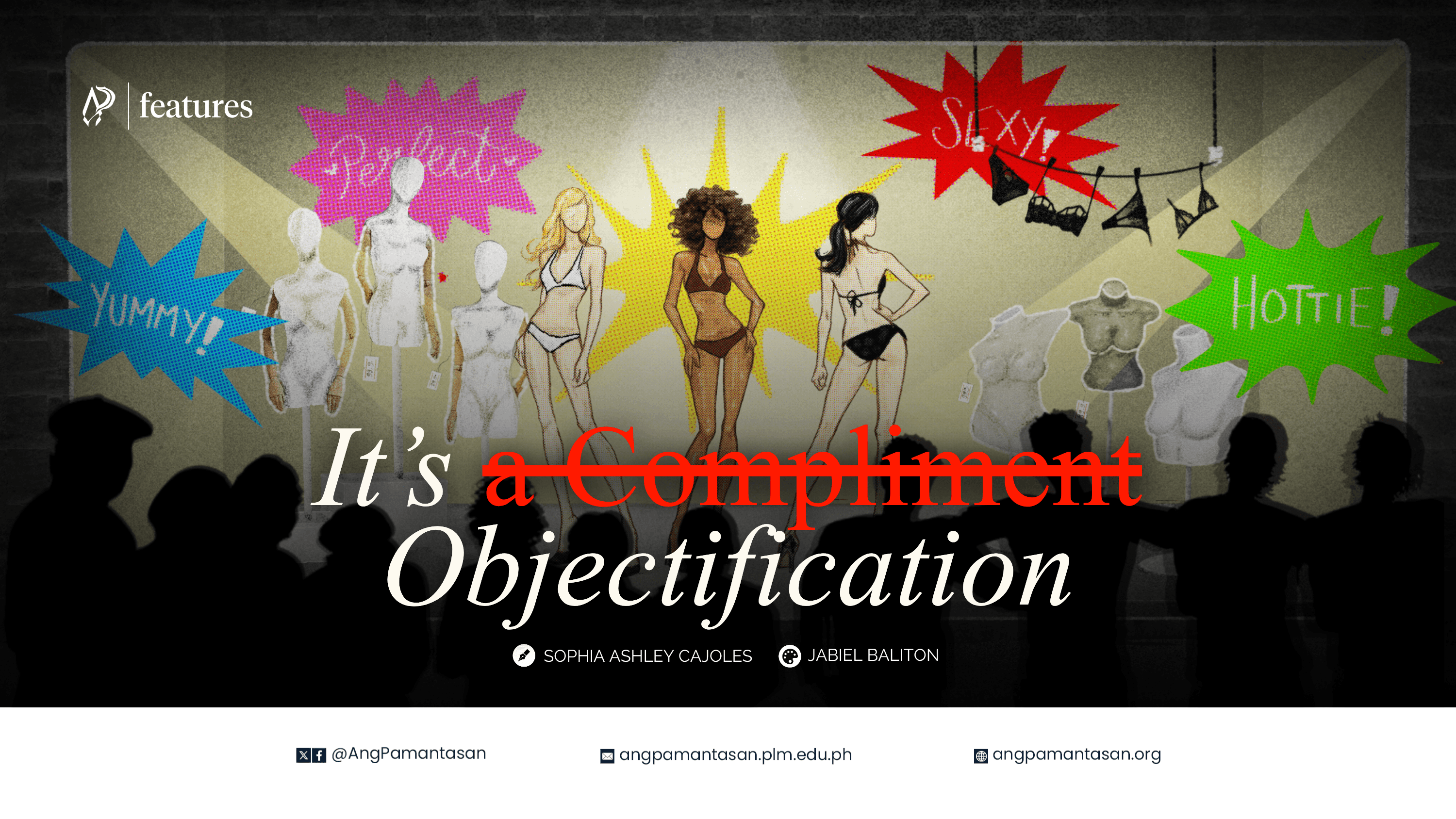
It’s a̶ ̶C̶o̶m̶p̶l̶i̶m̶e̶n̶t̶ Objectification
Written by Sophia Ashley Cajoles • Board by Jabiel Baliton | 7 April 26
While scrolling on your phone, you come across a video of a certain politician, you find it to be Quezon City Congressman Bong Suntay. He looked dignified, clean, and put together. You hit play and suddenly you are baffled. The words he spoke, the implications he made, how he lusted over actress Anne Curtis who he just so happened to see, even trying to justify his actions by saying:
“Pero siyempre, hanggang imagination lang yun.” And even following up with “Di naman ako siguro pwede kasuhan dahil kung ano-ano nai-imagine ko.”
It’s not the first time you’ve heard a woman objectified, but it dawns on you that whether a woman is in her home, on roads, at the workplace, or even places of leadership...
No woman is safe.
“It was just a joke, though!”
A suit and tie doesn’t hide the behavior beneath. What you’d think was a place of evolution and betterment for the country, turns into a display of offensive behavior.
For years, professional settings have been used as a pedestal of humiliation for women. Those who are supposed to be exemplary figures to the community display such behavior that it becomes normalized, if not delighted in.
Not only is this behavior utterly obscene, but it sets an authoritative image that younger males will want to emulate or copy.
Due to the lack of basic respect and decorum, professional settings in the Philippines have now turned into spectacles that shine an inappropriate light on women. Places like mayoral rallies, press conferences, and senate hearings, now turn into an open mic on the humiliation of women. Like for instance, in 2018, former President Duterte forcibly kissed an OFW woman in South Korea during a live broadcast, or the sexual innuendos that Davao de Oro Representative Ruwel Peter Gonzaga made during April 2025; saying how women and men aren’t equal because a woman chooses to either be on top or at the bottom, and he wasn’t talking about the corporate ladder, rather he was referring to positions in the bedroom.
It gets taken a step further though; with what is supposed to be a professional and distinguished environment—electoral campaigns, public events, political forums, give these dignitaries a space to make crude comments against women and then proceed to laugh it off like it’s a joke.
From hinting that single mothers are “welcome to their chambers” to implying that sexual assault must be “committed by the mayor first.” It’s unsettling how far these people will go, stating unnecessary and irrelevant comments to gain amusement.
It was never just a joke. It was a declaration of power; power over women. People who are in the position of governing over entire cities have no qualms to publicly and confidently use a distasteful language.
The Laughs that Fueled the Fire
Misogyny is not an old concept. It has been around for years, centuries even. The patriarchal standards that have plagued society still persist to this day despite the effort that women have put into fighting for equal rights.
Blatant misogyny gets played off as a joke as if it were an everyday occurrence.
Comments like: “Why are you so irritated? Are you on your period?” or “Women are so emotional”, only to be laughed at after. Humiliation and degradation became so ingrained into the minds of humans, that even fellow women develop “internalized misogyny.”
But they are not the only ones to blame. They made the jokes, but the fault also falls on those who laughed.
The laughter that rings out after every comment, the laughter that fuels the ego of every single person who looks down on women, and validates their hatred.
It’s never just a simple chuckle or snicker, a sound that was once associated with positivity and respect, now tainted with the cruel undertone of demeaning. A sound once thought to be one of joyousness and unity now turned to sour sirens of degrading behaviour.
Such comments may sound funny now, simply because the amusement of their speaker matters more than the respect and decency towards the subject.
The Stand Taken
Despite the portrayal of women as “weak” or “submissive” by male-centered media, women have risen above such backwards thinking. For the longest time, women have not accepted the humiliation. Despite all the progress, it cannot be helped that some distasteful behaviour is retained. But that doesn’t mean that they must be tolerated and enabled.
This women’s month has proven that times have not totally changed, and we still have a long way to go before true equality is attained. This year proved that even places of professionalism doesn’t stop distasteful behaviour from seeping through.
In what seemed to be impossible back then, became today's norm because women fought for it. The strides they made must not be tripped by men who reduce women into objects for their lust or desire.
Take offense. Be offended. Shame on who must be shamed.
Because every day, women fight these battles and all dream of a world where they don't have to.