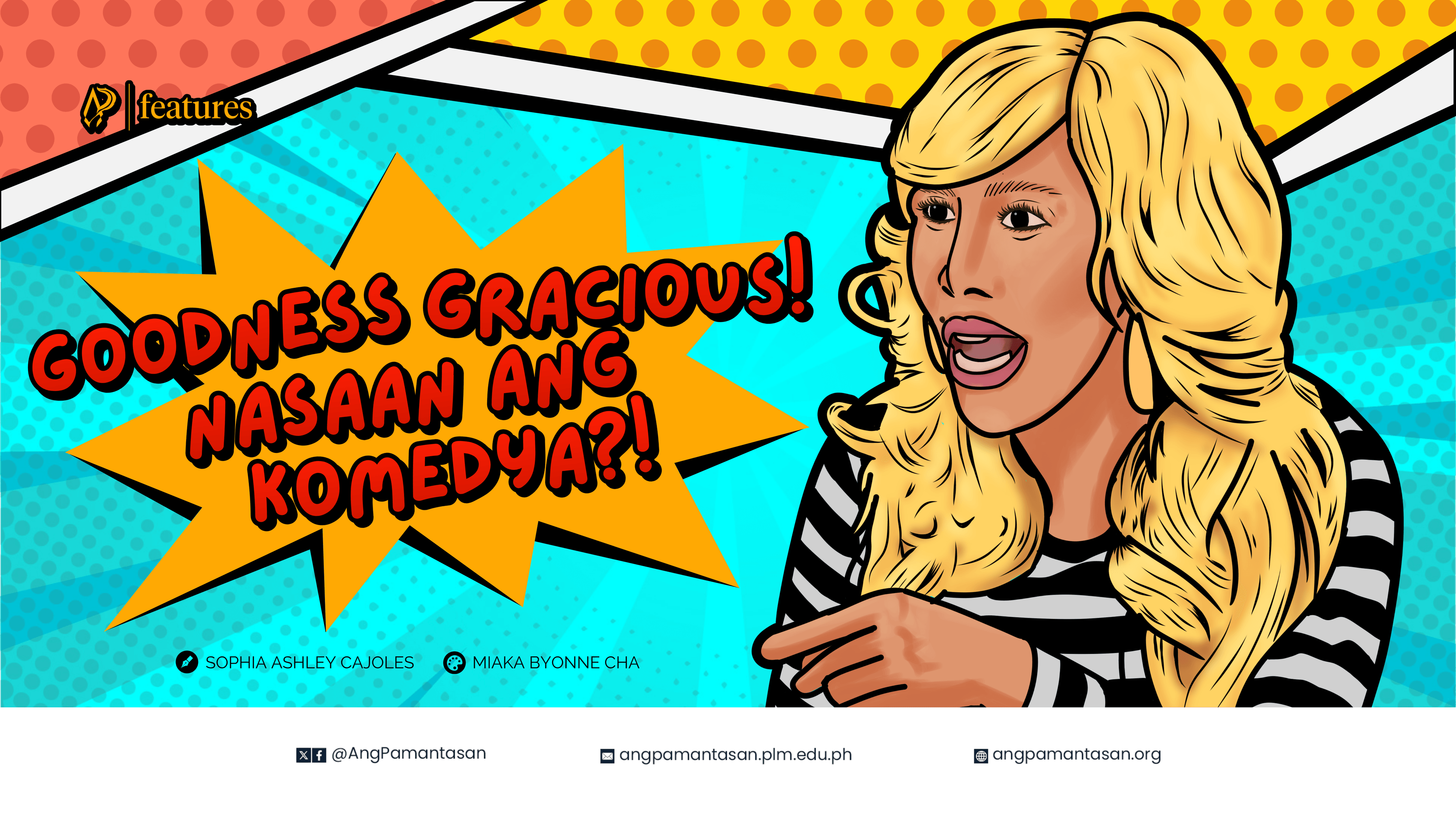
Goodness Gracious! Nasaan ang Komedya?!
Written by Sophia Ashley Cajoles • Board by Miaka Byonne Cha | 11 June 26
It’s a wonder what social media can do. Early this year, a resurgence of 2010s Filipino films were suddenly popping up from left and right, inspiring trends on TikTok and entering everyday conversations. Not only is it simply looking back on old films, but also reminiscing of our cinema’s roots and origins. Notice how comedies films from before weren’t scared to throw jokes around like a ball? How it brought smiles to citizens during their toughest times?
But what happened to this iconic genre?
Slapstick comedy was something that the film industry was filled with, and became what our cinema was most known for. But then as time went on, as more people became socially aware of different issues that emerged from certain comedic acts, the film industry of the Philippines took a step back from its iconic genre.
The Norms that Shaped Comedy’s Impact
Films like Ai Ai Delas Alas’ “Tanging Ina” and Vice Ganda’s “Girl, Boy, Bakla, Tomboy”, were filled with comedic lines and satirical themes that have been enjoyed for years, even rediscovered by younger generations. But despite the delight some people experience during their viewing, online discourse sparked awareness of how offensive some of the jokes used were. As Filipino humor is built in sarcasm and insult-comedy, it’s usually played off as a “joke” and viewed as a “j3j3m0n” sense of humor, with some netizens seeing it as “corny” or “try-hard.”
However, due to the evolution of social media, western influence, and social awareness, these films have been called out and were seen as “offensive” and “out of touch,” because it normalized otherwise unpleasant behaviour. Since insult-comedy was so widely used in films, it blurred the line between a joke and a cruel observation. Blatant insults were brushed off as something to laugh at, and when offended, it gets you called “sensitive.”
It turned from being a staple of Filipino culture, now seen as enabling examples for unpleasant behaviour. It’s no wonder that comedic-centred slapstick humour films are rarely produced anymore, with directors and producers scared to touch such projects in fear of the audience impact.
Philippine Cinema’s Lost Gem
Recent movies rarely included any comedy, and when they did, filmmakers were careful with the comedy they wished to portray in their masterpieces. It still hits our funny bones, but it doesn’t hit that iconic “Filipino humor” tingle anymore. There has rarely been a sight of comedy-centered film released aside from the annual Metro Manila Film Festival entries, which dilutes the genre to a once-a-year occurrence rather than the staple of Filipino cinema.
The Filipino cinema was filled with gems of comedy, but they were later buried under the “wokeness” of its recent audiences. Filmmakers are hesitant to create such a piece in fear of how it might be perceived. Take for example, Enrique Gil’s film, “I Am Not Big Bird” from 2024, only receiving a 5.3/10 on IMDb and a 2.9/5 on Letterboxd. The film was one of the few truly slapstick comedy films to come out in recent years, but because its themes centred around sex, despite its roots in Filipino comedy, it was not widely received.
It raises the question: where should the line between humor and offensiveness be drawn? While sensitivity has its place, excessive sensitivity can diminish the enjoyment of comedy and limit creative freedom. Jokes that are heavily constrained often lose their lasting appeal, causing films to feel tied to a specific moment in time rather than becoming timeless cultural works. In doing so, an important part of cinematic history and culture risks being left behind.
Laughs from the Past
Take the “mentality” trend on TikTok; for example, movies from even the early 2010s like “Moron 5” and “Sisterakas” are resurfacing due to younger generations discovering just how comedy was handled at that time and how lax audiences were. Or Vice Ganda’s Girlie’s iconic lines, “goodness gracious!” or “him ka, her ako! HAHAHA!”, making its way into slang used in everyday conversation. Despite the film being 13 years old, it still captured the humor of recent audiences.
Amid the many issues and challenges Filipinos face today, audiences often seek a brief escape from the pressures of everyday life. Traditional Filipino comedies once served this purpose, offering simple, lighthearted, and humorous stories that allowed viewers to relax their minds and forget their problems, even just for a while.
As local cinema increasingly shifted toward heavier and more socially conscious themes, an important avenue for escapism gradually perished. While these films play a valuable role in addressing significant social and political issues, not all movies are required to be “deep” to be good; sometimes, a good laugh is all it takes.
It’s Okay to Laugh, It’s Okay to Step Back
Comedy films are supposed to be for the audience; enjoyed by the audience and loved by the audience. If it isn’t your cup of tea, it’s easy to walk out the theater or click off your streaming platform.
While the current generation is viewed as “too sensitive” or “too woke” to enjoy the simple things in life, let’s not invalidate that they’ve been exposed to the world of social awareness and injustices early in their lives to find amusement in things meant to be taken lightly.
Slapstick and Insult-comedy still have an audience, they’re just waiting for someone to challenge the new norms and unearth this hidden gem of Filipino cinema once again.
Comedy isn’t dead, it just needs more room to breathe.