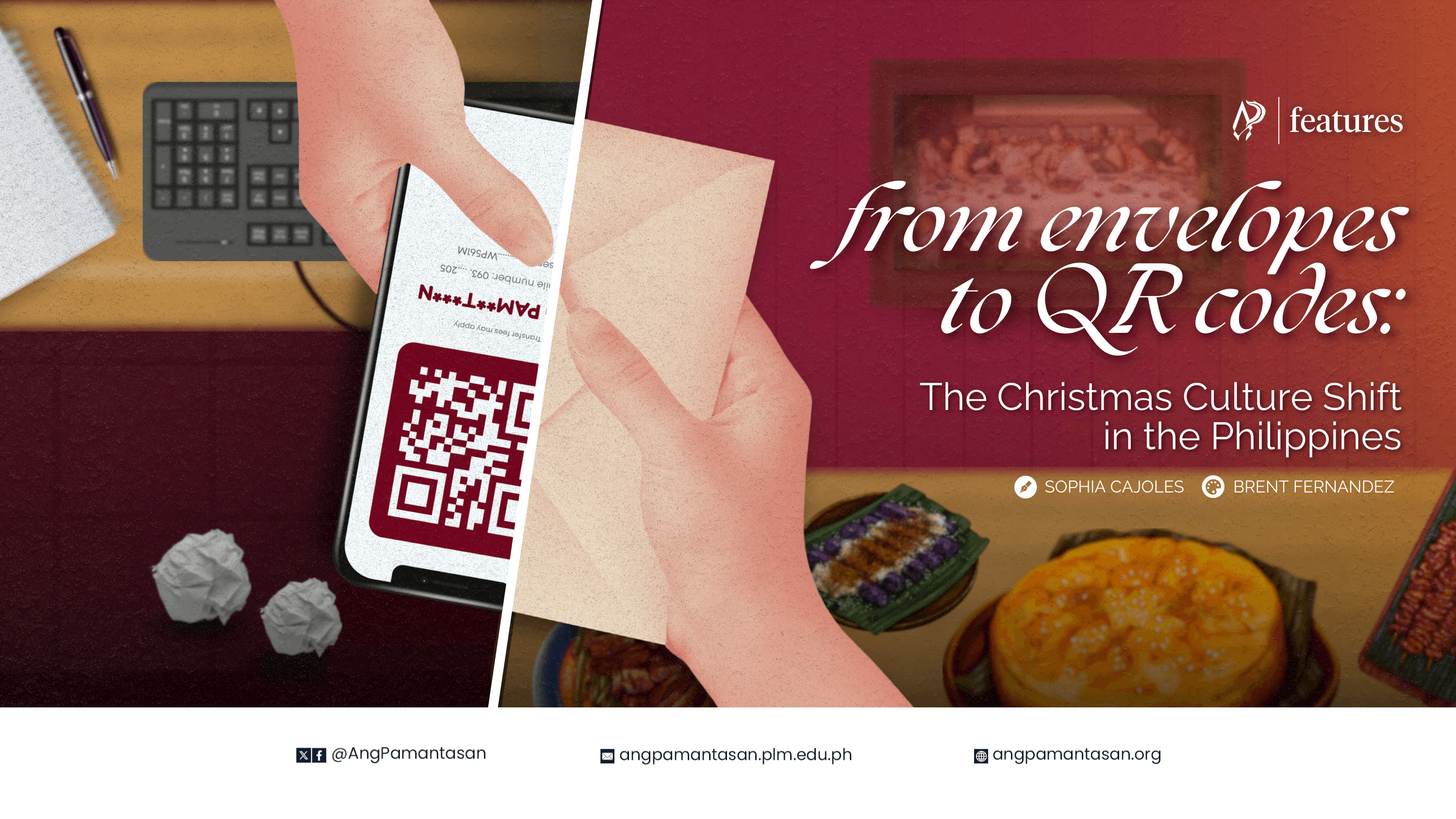
From Envelopes to QR Codes: The Christmas Culture Shift in the Philippines.
Written by Sophia Ashley A. Cajoles | 24 December 25
When calendar pages are flipped to September, and Christmas music begins to play in malls, Filipinos are embracing the holiday spirit from day one, through it all.
A running joke in Filipino culture is that once the month starts to end with “-ber”, Christmas has already begun. Kids start to make their Christmas lists, and adults start to save up and look forward to their Holiday bonuses. Noche Buenas are planned, and family members argue over whose house the holiday will be spent in. Malls are blasting classic Christmas tunes, and Jose Mari Chan begins to melt from his block of ice.
“No one loves Christmas more than Filipinos” is a common claim you’d hear from people all over the globe once the season starts to settle in. It wasn’t odd to see children in the streets singing, or foods like Keso de Bola popping up in grocery aisles, or even red envelopes for pamasko getting sold in a variety of stores, from malls to convenience stores. Christmas became a staple in Filipino culture, with the holiday marking gifts, food, and deep familial connections. No matter where you are, in the city or in the province, the Christmas spirit never fails to be felt throughout the country. Yet, all that came to a halt in 2020 when the pandemic hit the entire globe, putting the whole world on pause in a finger snap.
Interactions were limited, and gatherings were restricted, but for a lot of people, that didn’t stop them from celebrating Christmas with their closest friends and family. And while that is true, as the years progress, the way we celebrate Christmas has since changed.
A Digi-Christmas
With the world continuously spinning and technology’s never-ending innovation, has Christmas totally gone digital, or have we simply adapted with time, leaving old traditions behind?
Carolers used to grace the areas all around us. It didn’t matter if you lived in a gated subdivision or a tight-knit barangay in the city; you could hear the voices of children singing, sometimes accompanied by makeshift instruments or simply clapping their hands along to the beat. For years, it was a staple tradition where carolers knock on your door, serenading you with songs like “Star ng Pasko,” “Thank You, Ang Babait Ninyo,” and “Christmas is in our Hearts.”
But as time goes on, fewer and fewer children are engaging in this activity. And every year, fewer and fewer adults appreciate it, preferring to blast music on their speakers or engage in karaoke and sing the tunes themselves.
Even pamaskos that used to be given in the form of red envelopes called “Ampao” or “Aguinaldos” are now being given online via e-commerce platforms like GCash and PayMaya, often being used by millennials, who are somewhat familiar with online transactions. Shopping sprees in malls have been reduced to a quick check out on Shopee, Lazada or Shein. Even religious traditions such as Simbang Gabi can now be attended via YouTube or Facebook Live.
But why are we shifting from traditional Christmas customs to modernized versions of them?
A Celebration that Comes with Convenience
Among a number of reasons, a few stand out—convenience. A wider selection of options and a bigger reach with people.
Christmas Rush is not a joke, especially here in the Philippines. When December 25 draws near, places like Divisoria, Greenhills, and SM become a jungle of people doing their holiday shopping. Crowds get out of control as prices drop, and traffic barely moves with the swarm of cars on the road. It is these instances that contribute to the shift towards a more digitalized celebration, to ensure that the hustle and bustle of Yuletide doesn’t take away time for preparing the festivities.
In your relative’s homes in provinces, you might see an old record player stashed away in some part of the house. Before apps like Spotify and Apple Music, sources of our holiday tunes were CDs, Carolers, and music from make-shift instruments. Because of the development of the aforementioned apps, not only does it make it convenient to curate and access Christmas tunes, but it also joins inventions like karaoke machines, adding a more musically fantastical twist to the holiday.
Even Aguinaldos from Ampaos are now transitioning to QR Codes, as gifts with cash can now be sent through digital platforms. Ninongs and ninangs are no longer safe; family members aren’t too far anymore, and busy schedules and unavailability are no longer hindrances. People from all around can now express their love and affection, even without their physical presence. Because of platforms like Shopee, Lazada and TikTok, with just a few clicks, your wishlist is fulfilled and delivered to your doorstep; hassle-free and Christmas shopping is done, even without leaving the comfort of your home.
“May tatalo pa ba sa Pasko ng Pinas?”
Though we have transitioned into a new age of advanced technology, the Christmas spirit has not diminished—it has evolved in a way that accommodates people unlike some that we got used to. It allows for more flexibility and provides a wider range of selections when it comes to gifts, connections, and music. It has opened doors to new avenues, still igniting the spirit of Christmas, while embracing modernity.
We don't have many carolers on the streets, but instead blast Station IDs on repeat with our friends and families. Different, but at its core, it's playing towards the same goal: to spread Christmas cheer. Simbang Gabi, whether joined in church or during livestreams, still carries the same message of hope and love. While we click “check out” on our desired items and play a Christmas movie in the background, we don’t forget our old traditions; we honor them. Virtual Ampaos or not, the fact that the sender allocated a part of their daily allowance or monthly salary for you is a gift on its own, no matter the medium or amount.
Because of the digitalization brought on by constant innovation, Christmas is felt and shared no matter where you are, and it is enjoyed with easier navigation. You could see it as the Philippines having its old holiday sparkle, with a touch of digital magic.
There is no “right” way of celebrating the holiday, and there is no shame in doing what works with your lifestyle or preference, as Christmas is meant to highlight a joyous time of togetherness and love. Whether you choose to celebrate the holiday the old-fashioned way or the newer modern way, it doesn’t matter, because at the end of the day, Christmas is about spending time with the people you love.