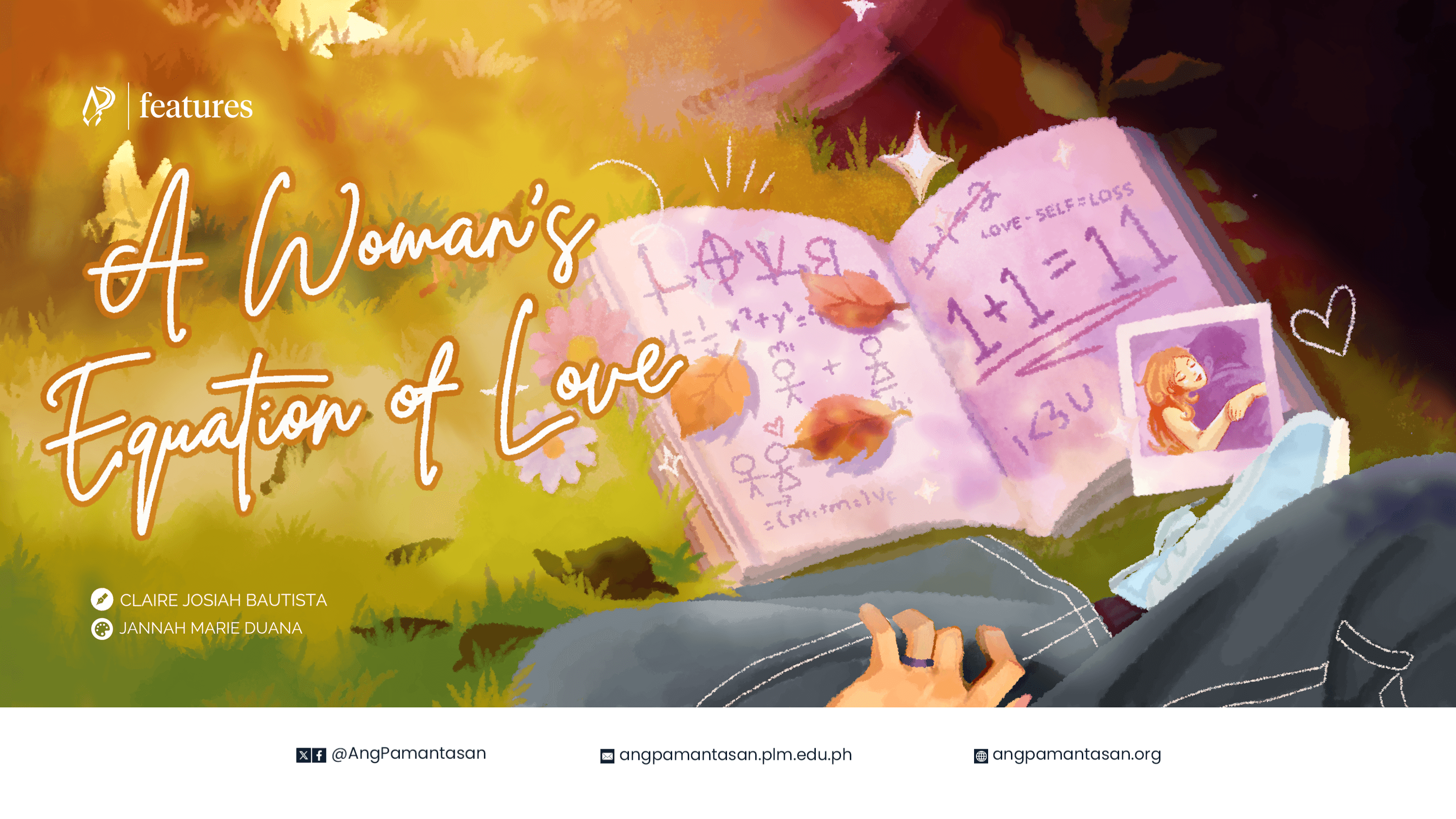
A Woman’s Equation of Love
Written by Claire Josiah Bautista • Board by Jannah Marie Duana | 29 March 26
Somewhere along the way, love was reduced to arithmetic—clean, predictable, easy to solve. But a woman’s love has never followed simple equations. It is not confined to balance sheets or neat conclusions. It is layered, intuitive, and often invisible in the ways it stretches, gives, and endures. In a world that constantly asks women to measure, to minimize, to make themselves easier to understand, the way they love refuses to be simplified. It is lived in quiet sacrifices, in resilience, in the courage to feel deeply and still remain whole. A woman’s equation of love is not meant to be solved—it is meant to be honored, in all its complexity, its contradictions, and its power.
Why 1 + 1 = 11
The idea that 1 + 1 = 11 suggests something radical in a culture that asks women to soften, or shrink to fit love. This is the same culture that is obsessed with merging: that love should amplify, not erase. That a relationship is strongest not when two people dissolve into each other, but when they stand side by side—distinct, whole, and still fully themselves.
To say 1 + 1 = 11 is to refuse that idea of narrowing. It suggests that love should amplify rather than erase individuality. That intimacy does not demand disappearance. When two people stand side by side—rooted in their own experiences, preferences, boundaries, and contradictions—the relationship grows wider, not smaller. Their differences do not cancel each other out, but they multiply perspective, depth, and endless possibility.
This equation reimagines love not as fusion, but rather as an expansion. Not transforming into someone as less, but as becoming louder, richer, more layered. Two whole people bring more into the relationship precisely because they remain distinct. Carrying their differences, diverse talents and strengths, ever stronger than before.
The Subtle Subtraction of Self
Yet relationships often begin with quiet negotiations. Women adjust, listen more than they speak, shift routines, or soften dreams to make space for someone else. Compromise is sold as romance. Sacrifice is reframed as endless devotion. And because each concession seems reasonable on its own, the pattern goes unnoticed. What begins as simply becoming flexible slowly turns into self-editing. Love turns into a process of subtraction, so gradual, bit by bit that no one sees what is slowly disappearing.
There is no single moment where the loss is clear. It accumulates slowly, deep into the cracks—in the interests that are no longer pursued, the opinions left unsaid, the dreams postponed indefinitely. Women love by giving, but too often they forget to keep themselves whole. The equation feels balanced because it has always felt this way. Until one day, standing still feels unfamiliar, and the question emerges: when did loving someone start requiring so much erasure?
By then, the math has already changed.
Veering Variables and Values
This is where compromise and collapse begin to blur—where the variables of love start veering off balance. Healthy compromise asks two people to meet halfway. Collapse happens when the halfway point keeps shifting, slowly and subtly, until one person is doing all the moving. What once looked like flexibility becomes expectation. What once felt generous becomes obligatory.
Love is never made of positives alone. Every partnership carries its negatives —misunderstandings, impatience, poorly chosen words. The problem is not their presence, but their proportion. When criticism outweighs encouragement, when control outweighs care, when silence outweighs honesty, the values shift. The equation tilts.
But when the positives carry more weight—if warmth outweighs tension, if patience outweighs frustration, if effort outweighs expectation—the relationship holds. Love adds reassurance where doubt appears. It subtracts harm before it can settle. Over time, these small calculations shape everything. A single negative does not undo love; a pattern where negativity is greater than care slowly does.
Love is not about reaching zero conflict. It is about making sure the positives consistently outnumber what drains, diminishes, or erases. That is how relationships endure—not by perfect math, but by mindful balance.
Addition Amplifies Affection
A healthier equation begins with addition. Love should add—safety, laughter, warmth, and depth to the life that already exists, not replace it. It should magnify what is good, highlight what is meaningful, and expand joy rather than demand conformity.
Partners are not variables designed to cancel out past passions, friendships, or personal identities. Each person brings their own colors, quirks, and experiences, and together these differences do not subtract, instead they compound, enrich, and illuminate.
A relationship should feel like an open sum, a growing total of two lives intersecting without erasing the individual. Love that adds, builds, celebrates, and multiplies the existing world instead of shrinking it to fit someone else’s formula. In essence, addition in love is not just arithmetic—it is alchemy, transforming the ordinary into something greater than the sum of its parts.
Multiplication Magniffies Meaning
Multiplication is where love reveals its true power. The right partnership multiplies joy, courage, and confidence—turning ordinary moments into shared meaning that resonates far beyond the immediate. Laughter becomes louder, courage becomes contagious, and small victories feel monumental because they are celebrated together.
Love does not demand transformation for its own sake; it magnifies what already exists. Growth is supported, not coerced. Hopes are shared, strengths are reinforced, and vulnerabilities are met with trust rather than judgment. In this way, love multiplies not only experiences, but possibility itself, creating a life richer than either person could build alone.
It is not about becoming better for someone—it is about becoming better with someone. Together, the equation expands: one plus one does not merely add, it amplifies, turning ordinary companionship into something extraordinary.
Division Delivers Distance
And then there is division—not the kind that separates, but the kind that delivers space. Space for personal passions, private dreams, and quiet solitude. Love does not demand duplication; it thrives in distinction. One need not mirror every hobby, opinion, or thought to be close.
Difference does not dilute intimacy—it deepens it. Separate rhythms, unique routines, and independent pursuits enrich the relationship, creating room for growth, curiosity, and self-discovery. Two parallel lives can move forward together without collapsing into sameness, and in that balance, love finds its strength. Division in love is not subtraction—it is sustaining the sum. By honoring individuality while choosing each other every day, partners ensure that the relationship is expansive, resilient, and alive with every possibility.
The strongest love resists tidy conclusions. Love is not meant to equal two, or one, or anything easily defined. When love is healthy, 1 + 1 does not become 2. It becomes 11—louder, fuller, and more expansive than either person alone.
Women love with courage, resilience, empathy, and depth. They love while remaining whole. Love is not about becoming less to keep someone. It is about being fully present, fully oneself, and choosing—again and again—to stand beside another whole human being. That is the only way that math would ever truly work.